

Whiskey Tango Ford!
When the US Navy names its ships and submarines, it does so with the point of honoring great Americans. However, are we allowed to say that not all Americans deserved to have one named after them?

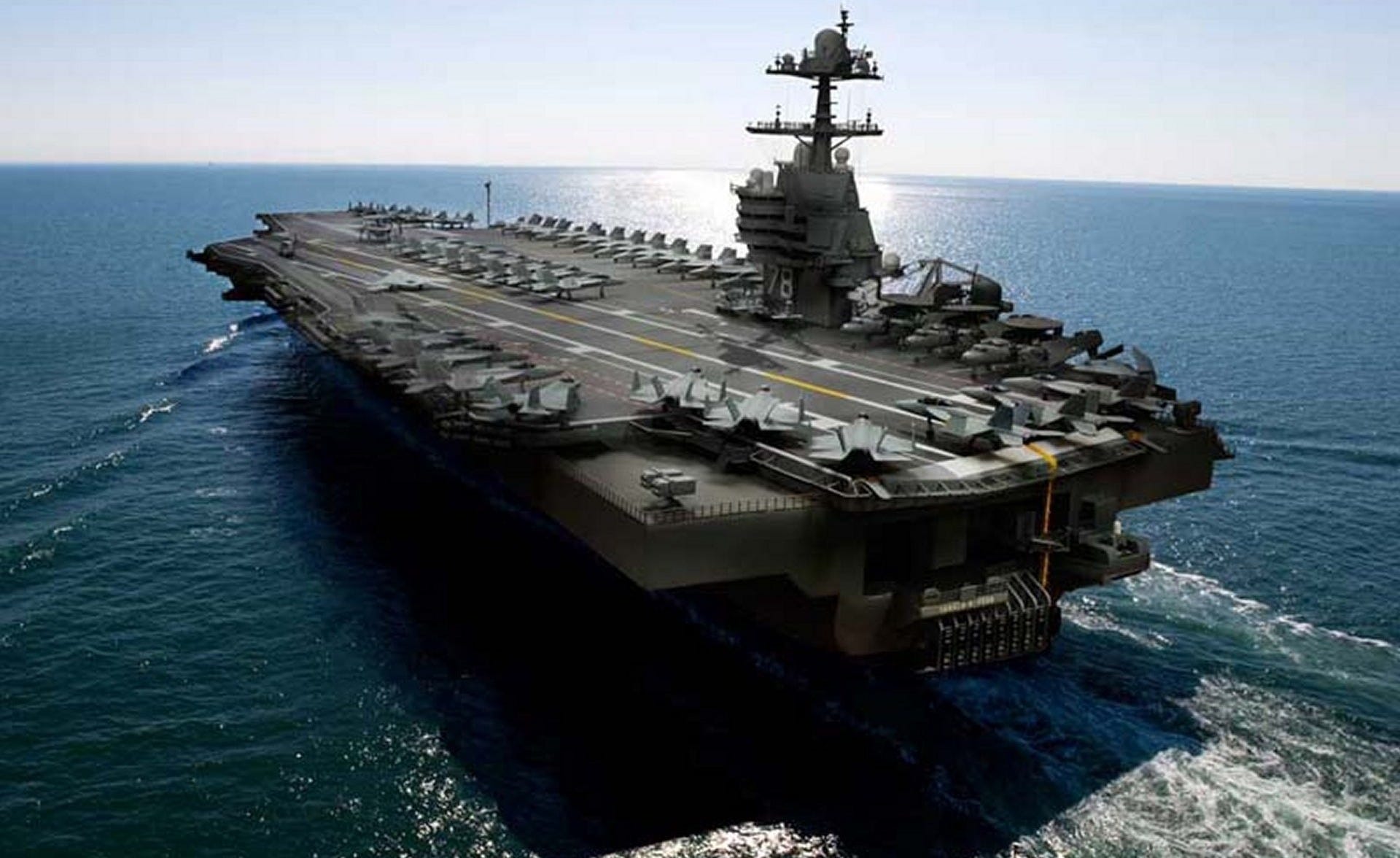
Under Title 10 in the Federal statutes, 10 US Code 8062(b), our “Navy shall include not less than eleven operational aircraft carriers…” For the last six decades, the United States Navy has relied on nuclear-fission-powered aircraft carriers, beginning with USS Enterprise, followed by ten USS Nimitz-class behemoths. Additionally, steam-turbine carriers USS Forrestal, USS Saratoga, USS Ranger, USS Independence, USS Kitty Hawk, USS Constellation, USS America and USS John F. Kennedy (CV-67) filled similar roles until they were decommissioned and eventually scrapped or scuttled. With the February 2017 decommission of the Enterprise and scheduled retirement of the Nimitz, the Navy commissioned their modernized replacements – one of which is the USS Gerald R. Ford-class named for our thirty-eighth president.
The order for this lead ship was awarded September 2008 (almost two years after his passing), and the Ford was commissioned in July 2017. The Ford-class employs the electromagnetic aircraft launch system (EMALS) to replace the reliable, but maintenance-demanding, steam catapult, as well as a more advanced reactor for propulsion and modern phase-array radars, among other augmentations. Follow-on ships of this class include the USS John F. Kennedy (CVN-79), USS Enterprise (CVN-80) and USS Doris Miller (CVN-81), named for a heroic enlisted seaman, the latter two being currently under construction.
A week before departing the White House Joe Biden (or whoever controlled his autopen) named the next two carriers after a pair of his still-living predecessors Bill Clinton and George W. Bush (i.e., numbered presidents 42 and 43). Upon my learning this, the phrase from the movie title Whiskey Tango Foxtrot (2016) immediately comes to mind for its vulgar NATO alphabetic abbreviation that is frequently used by members of the military. So basically, the United States Navy will now be sailing two powerful combat ships that are named after: 1) a draft-dodging playboy who through his “peace dividend” military drawdown left America vulnerable to Islamic terrorists, and 2) a do-gooding nation-builder who stumbled into desultory strategic debacles on both the Central Asian and Mesopotamian fronts. Both men squandered the lives of uniformed personnel along with matériel to chase neocon phantoms in regions unrelated to national security, while China was allowed to slowly awaken from its long slumber.
Does this country lack a plethora of other historical figures to honor with such platforms? We have nineteenth century presidents who have had (now decommissioned) missile submarines launched in their names, including the USS Thomas Jefferson, the USS Andrew Jackson, the USS James K. Polk, and the USS Ulysses S. Grant. Continental legends with similar honors include a colonel (USS Ethan Allen), our first treasury secretary (USS Alexander Hamilton), a patriot and spy (USS Nathan Hale), a general (USS Nathanael Greene), and an ambassador and founding father (USS Benjamin Franklin). More contemporary recipients include a famous inventor (USS Thomas A. Edison), a long serving statesman as army Chief of Staff and Secretaries of State and Defense (USS George C. Marshall), as well as an agricultural scientist (USS George Washington Carver).
Additional names previously bestowed on illustrious naval officers include Rear Admiral John A. Dahlgren (USS Dahlgren) and Commander and Nobel laureate Albert A. Michaelson (USNS Michaelson). There are plenty more noteworthy Americans worthy of recognition whose names have never graced a naval warship. These include escaped slaves and abolitionists Frederick Douglass and Harriot Tubman, as well as civil rights leader Booker T. Washington. The advancement of technology suggests consideration of naval aviator-moonwalkers John W. Young and Eugene A. Cernan, or head-turning actress and co-inventor of frequency-hopping torpedo guidance Hedy Lamarr. As a suggestion, perhaps we could retain the last names for the newly planned CVN-82 and CVN-83, but simply swap out the first names and middle initials in the first case with “George C. Clinton” for the fourth Vice President, and in the second case “Vannevar Bush” for the illustrious inventor and research administrator in the 1940s.

Moreover, it should be considered that naming combat vessels after living persons might be a bit myopic – as if political favors for convenient allegiances are being procured. Our leadership started this path with the Nimitz-class USS Ronald Reagan, named after our fortieth president, but one could argue he deserved that honor as one of our greatest leaders from the prior century. But then this became compounded by naming the third and final Seawolf-class submarine the USS Jimmy Carter after the thirty-ninth president and the USS George H.W. Bush, the last Nimitz-class carrier after the forty-first president, with these single-term presidents attending the formal christenings. On the other hand, both (now deceased) men had served in the Navy, which would seem an appropriate rationale for the namings.
However, these justifications decidedly do not apply in the case of the forty-second and forty-third presidents who both led this country into a ditch of trade globalization and international destabilization. It is true that Americans have voted for many mistakes – out of either ideological blindness or wishful thinking. But we should not reward these errors by naming our country’s vital military warships so casually.
Photo Credit- Wikicomons.
 | A guest post by
|
Anything was allowable, not matter how slimy, under the last admin. Personally, I do not think the government should be naming anything after people who are still alive. Preferably, people who have been dead for at least 20 years. That would give time for history to catch up to the political hype. The Post Office does not (at least they didn't years ago) put people on postage stamps until they have been dead for at least 10 years. That is a reasonable policy.