

Support for Abortion Rights by Catholic Politicians: What is the Truth?
In light of recent comments made by Nancy Pelosi, who claims to be a "devout" Catholic, many non-Catholics are left wondering: what is the official position of the Catholic Church on abortion?

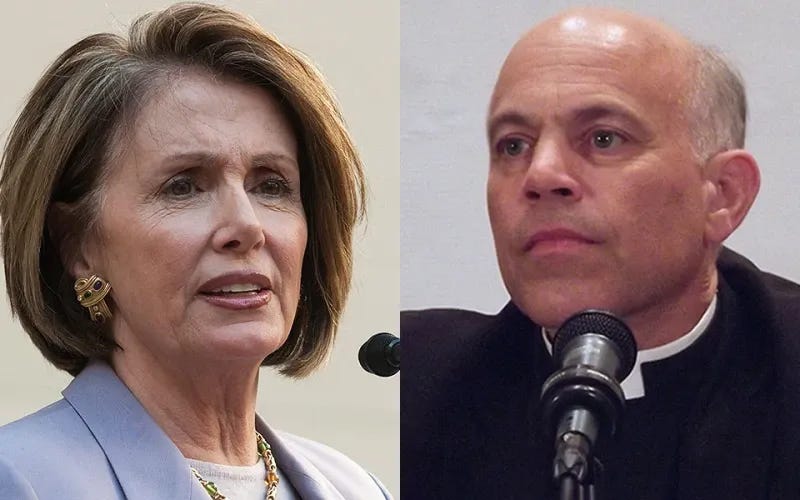
In an interview published on Tuesday, December 10, former Speaker of the House Nancy Pelosi (D-CA) spoke on a wide range of topics including the recent election, China, the Pope, as well as her Catholic faith. Due to her well-known pro-abortion stance and because of her abortion rights advocacy, the interview made reference to a mandate that was recently imposed on her by her bishop to stop receiving communion. Over the years Nancy has described herself as a “devout Catholic,” but at the same time has publicly supported abortion. This has left many non-Catholics wondering: what exactly is the teaching of the Catholic Church on the topic of abortion?
The answer is actually quite easy to confirm, as the official position of the Catholic Church remains unchanged, and is recorded in a published summary of the essential and fundamental elements of Catholic doctrine, the Catechism of the Catholic Church.
The Catechism
The Catechism of the Catholic Church (also referred to as the “Catechism” or the “CCC”) is a major source of Catholic teaching and doctrine. The Catechism seeks to help deepen the understanding of the faith, and serves as a guide for Catholic teaching on important matters. It is intended to serve as a point of reference for the catechisms that are composed in the various countries. Although it was primarily intended for those who are responsible for catechesis (i.e., the bishops), it is also intended as useful reading for all other practicing Catholics.
The Abortion Discussion: Where to Begin?
The secular conversations that have taken place on abortion over the last few decades have failed to focus on the most important issue. The fundamental question isn’t necessarily the rightness or wrongness of the practice of abortion, but rather whether the unborn are in fact people/persons.
From a philosophical/religious perspective, the starting point for what constitutes a “person” has historically been connected to the concept of ensoulment. The term “ensoulment” is generally understood to address the moment at which a human being gains a soul. In Sacred Scripture the term “soul” often refers to human life or the entire human person (CCC 363). The Catechism says specifically that “every spiritual soul is created immediately by God” (CCC 366). This appears to indicate that our souls are created at our conception, and not slowly over time or at some later date. This same conclusion (that each human soul is created immediately by God) is repeated in the definition of a “soul” that is found in the Glossary section of the CCC, and is also confirmed in CCC 382.
Are the Unborn/Pre-born Persons?
A fundamental point related to the analysis of the personhood of the unborn is made in CCC 1700, which provides that “The dignity of the human person is rooted in his creation in the image and likeness of God.” However, in order to confirm that this paragraph applies to the unborn, the basic question must be answered of whether the unborn are in fact “human persons.”
While not including any reference to ensoulment, the Catechism directly addresses the issue of personhood for the unborn in its sections on abortion. For example, it indicates that “from the first moment of his existence, a human being must be recognized as having the rights of a person” (CCC 270). CCC 2274 further provides that an embryo “must be treated from conception as a person.”
But What Exactly is a Person?
The general topic of personhood is addressed by the CCC in several of its other sections. In its definition of a human “person,” the glossary at the end of the CCC informs us that a person is:
…made in the image of God…a unity of spirit and matter, soul and body, capable of knowledge, self-possession, and freedom, who can enter into communion with other persons—and with God…
While this definition provides some degree of support for the unborn as persons, it is not entirely clear on the matter. Thankfully, CCC 362 provides clarity by stating that the “human person, created in the image of God, is a being at once corporeal and spiritual.” This would appear to indicate that human personhood occurs immediately (i.e., at conception). Even though there is no reference to ensoulment in this paragraph (as the event which creates personhood for a human being), the wording is consistent with the positions found in CCC 366 and CCC 382 (both referenced above).
From the perspective of the unborn/pre-born, perhaps the most illuminating section of the Catechism that deals with what constitutes a person is CCC 2319. This paragraph is found in an “In Brief” section of the CCC, which are used to sum up the essentials of that unit’s teaching in a condensed format. It states that “Every human life, from the moment of conception until death, is sacred because the human person has been willed for its own sake in the image and likeness of the living and holy God.” This language is perhaps the strongest indication that personhood begins at conception. Similarly, another In Brief paragraph makes clear that “…the human person is from his very conception ordered to God and destined for eternal beatitude…” (CCC 1711).
In addition to confirming the human personhood of the unborn, other In Brief paragraphs confirm that from conception every unborn person is also a child (CCC 2322), a human being (CCC 2323), and has the right to life (CCC 2322).
Is it Possible to Reconcile Support for Abortion with the Catholic faith?
In the interview on Tuesday Nancy Pelosi said that at the heart of her Catholic faith is her belief in the “divine spark within every individual.” She added “That spark of divinity is what I respect in every person…” As summarized above, there does not seem to be any significant doubt in the teachings of the Catholic Church that the unborn/pre-born are persons, with immediate souls from the point of conception.
Based on the official position of the Catholic Church (as explained in the Catechism), it should therefore be fair to ask Nancy Pelosi—as well as any other Catholic you may know or encounter—the following question:
On the topics of abortion and the personhood of the unborn, how does your Catholic faith align with the historic and present-day teachings of the Catholic Church?
Photo Credit- SF Chronicle.
Excellent. As a Catholic, I realize I'm flawed and am a sinner. However, obstinately saying that what you believe is fine, even though it's directly contradictory to fundamental teachings of the Catholic Church renders one a..."Protestant", correct? (No offense intended to faithful Protestants, mind you...)