

The Modern Solar Delusion
The push to replace fossil fuels with "renewable energy" is fraught with difficulties which its advocates would prefer not be discussed. Solar energy is a prime example of this fact and here's why.

Solar power derives from light photovoltaic panels that receive light emitted from the sun. Edmund Bequerel discovered this effect in 1839 by observing that electric current by a platinum electrode immersed in electrolyte was activated by visible light. The physical process was explained by Albert Einstein in his 1905 paper “Über einem die Erzeugung und Verwandlung des Lichtes betreffenden heuristischen Gesichtspunkt” (“On a Heuristic Viewpoint Concerning the Production and Transformation of Light”) in Analyk, for which he received a Nobel prize in 1921. Einstein explained that threshold photons with wavelengths sufficiently short to energize electrons beyond their atomic orbitals move charges for carrying electric charge and induce current.
The photoelectric effect generates electric potential differences from the absorption of a photon whose energy excites a negatively charged electron around its atom’s nucleus. Oversimplified, this elevation in orbital state leaves a corresponding positively charged “hole” that drives electric current by the localized difference in electric charge before another electron recombines with the hole. Semi-conductor materials, such as silicon, produce voltage potential from these charge movements, thereby enabling construction of photovoltaic cells to provide electric power from solar radiation. Alternatively, photons can also be reflected by mirrors to concentrate energy into thermal storage.
Solar power has been instrumental in providing electrical power for applications in which more efficient generators become less convenient, often due to weight considerations, such as operations in outer space. For example, weighing just over three pounds Vanguard 1 (launched in March 1958) became the first artificial satellite equipped with solar panels, and remains in orbit today as the oldest such object in orbit around the earth. The instrumentation/propulsion module of Soviet/Russian Soyuz manned spacecraft included solar panels (except the 7K-1 model used from 1973-1981), along with SpaceX’s Cargo Dragon spacecraft. Solar panels have also routinely powered space stations since 1971, including the Salyut (Soviet) and Mir (Russia) series, Skylab (United States), International Space Station and Tiangong (China) series.
The Paucity of Renewable Energy
Climate change alarmists accept only “renewable” forms of energy, which currently supply less than twelve percent of our energy needs, and seek the replacement of “fossil” fuels (overwhelmingly which is the burning of waste and biomass). Meanwhile, eco-fascists spurn further development of hydroelectric dams or nuclear fission, but deceptively conceal their intended desire for energy scarcity. An online book titled Sustainable Energy by David McKay provides additional background information explaining various sources.
However, before going further, we shall take a brief digression to our definitions. Energy is measured in joules (J), while power is measured in watts (W). One joule equals work performed by displacing one newton of force displacing a mass of one kilogram by one meter against earth’s gravity at sea level. One watt equals one joule per second (Js–1), and one kilowatt (kW) converts to 1.341 horsepower. By popular convention, energy has been often expressed by the clumsy watt-hour, which is equal to 3600 J. Typically, reports on energy sources list power delivered, because for combustion especially, roughly half of generated power constitutes waste heat due to thermodynamics and conversion efficiencies.
According to the International Energy Agency, carbon based fuels (coal, oil and natural gas (methane) in 2019 provided over four-fifths of global energy supply of 606 exa-joules (EJ) or 6.06×10²⁰ joules annually (6.06 E+20 J). Over a year, this averages to global power of 19.2 tera-watts (TW or 1.92 E+13 W). Of that worldwide total, the United States consumed 93 EJ at a rate of 2.9 TW. By comparison, solar photovoltaic use has rapidly grown to globally supply 2.45 EJ, but still only 0.4 percent for that year. Any and all attempts at expanding this quantity at scale faces daunting manufacture and installation challenges.
As under-developed nations raise living standards from poverty while maintaining their high population growth, the public can expect energy demand around the world to further increase substantially. Replacing energy producers that emit carbon-dioxide will necessitate scaling proposed renewable sources upward by at least two orders of magnitude. This would be coupled with energy storage to compensate for earth’s diurnal cycle (and variability in cloud cover).
A 2022 federal study “Examining Supply-Side Options” proposes quadrupling or quintupling wind and solar power by 2035, as well as doubling or tripling transmission line capacity. The National Renewable Energy Laboratory (NREL) asserts that the land area devoted to wind and solar would be less than twenty-thousand square miles, and could be co-located with agriculture. Proceedings of the National Academy of Sciences (PNAS) published “Low-cost solution” as an assertion of reliable low-cost grid power through renewable sources coupled with hydrogen storage and reduced demand.
A rebuttal “Evaluation of a proposal” in PNAS challenged its analysis and feasibility, joined by further debate in Renewable and Sustainable Energy Review. These papers include “Burden of Proof” and its “Response” arguing respectively against and in favor of transition towards solar power for satisfying global energy demand. All this analysis boils down to how much societies should pay for this chimera to ease the consciences of climate doomsters before conjuring another hobby horse with which to hector the plebes. Nonetheless, further explanation requires the presentation of some quantified detail.
The Grim Truth About Solar Energy
From its orbital distance from the sun, earth receives an average extraterrestrial irradiance of 1.37±0.05 kilowatts per square meter (kWm–2, equivalent to giga-watts per square-kilometer) varying within seasonal range. Only about half of this radiation reaches the surface at normal (i.e., perpendicular) incidence, with the remainder being reflected to space, scattered by clouds and dust, or absorbed by the atmosphere, although this quantity varies by wavelength. At the noon hour, the surface directly facing the sun receives an average of 0.70 kWm–2 or 0.70 GWkm–2.
While this sounds impressive (because without that, we would die of course), that value neglects cloud cover and incident angle deviation from latitude, as well as the diurnal cycle as earth rotates on its polar axis. A national solar radiation map shows average incident power flux at 0.21 kWm–2 with a few desert regions in the American southwest receiving 0.29 kWm–2 across the day or about two-fifths from the peak. (The World Bank provides similar global maps.) Moreover, photovoltaic cells have conversion efficiencies of between fifteen and twenty-five percent. Hence, the extractable power flux from southern deserts reduces to about 60 Wm–2 over the course of a day.

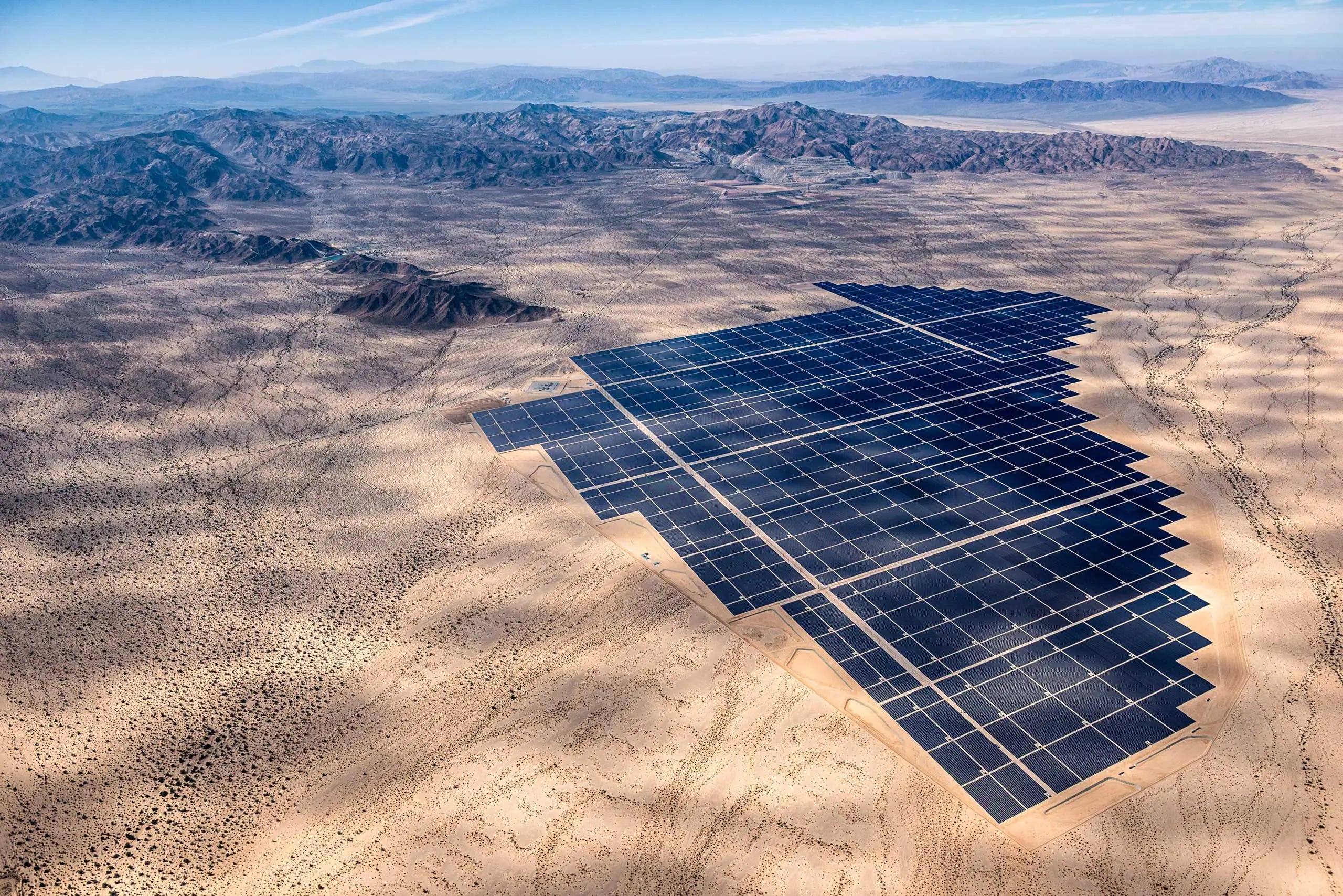
This article’s feature photograph shows the Desert Sunlight Solar Farm that occupies 4410 acres (17.8 km2) in the Mojavé desert with almost nine million solar panels that provide 550 MW (daily average). Each cadmium telluride module measures 2 ft×4 ft. The power density translates to 30.8 MW km–2 of power to land usage. The land encumbrance from intermittently operating windmills is even worse. By contrast, the smallest domestic nuclear power plant, R. E. Ginna in Ontario, NY on 426 acres (1.72 km2) and commissioned in 1970, generates continuous 580 MW. Propagandized voters decline to fund or build a constant power availability on less than one-tenth the footprint, and instead support the subsidization of an impractical alternative to virtue signal over manufactured atmospheric hysteria, while being in utter phobia of chemical combustion and nuclear reaction phenomena.
To domestically generate America’s 2.9TW current demands (not counting battery storage and transmission cables), that power divided by photovoltaic delivery would require twenty-four billion panels, which themselves occupy nearly fifty-thousand km2! Actually, even that is not enough. Mojavé’s installation requires 16.5 km2 of area to distribute the panels. The nation would need over five thousand such farms covering nearly eighty-seven-thousand km2. This That amount of area corresponds to the states of West Virginia and Maryland being completely plastered with solar panels. After three decades of use, Americans would then need to repeat this endeavor and recycle the hazardous waste from the consumed (and now useless) panels.
The Truth About the Green Scare
All this quantification leads to the obvious question: if alarmists project imminent environmental catastrophe from continued reliance on coal and oil, then why do they categorically reject expansion of nuclear power? This natural boon in the form of water-cooled uranium fuel rods bombarded by neutrons has been extensively studied and found historically safe while exhibiting minimal footprint and zero carbon emission. This safety record discounts the destruction of a graphite moderated RBMK at Chernobyl. The obstinate rejection of fission reactors in favor of “renewable” ambient collection belies an absence of seriousness regarding “climate change” as their motivation. Instead the attention-demanding acolytes of “renewables” seek political cover for tyrannical imposition of diminished living standards onto a gullible public.
Wake up America. Ignorance is not just bliss – it’s complete folly.
Photo Credit- Dreamstime. com
 | A guest post by
|
"All this analysis boils down to how much societies should pay for this chimera to ease the consciences of climate doomsters before conjuring another hobby horse with which to hector the plebes."
One of the funniest bits of mockery I've read in quite a while!