

The King Returns- Captain America: The First Avenger
They say that King Arthur will return in his country’s hour of need. America has no king – but she does have a Captain.


America has always been the “shining city on a hill,” but what does that actually mean? Marvel’s Captain America: The First Avenger, released July 22, 2011 in the U.S., opens in the cold ice and snow of Greenland. A detachment of American soldiers cuts their way into a strange plane revealed by shifting ice, where they discover a shield with an American flag motif. “This one’s waited long enough,” one of the men says as he calls his boss with some momentous news.
The film flashes back to 1942, where a man with a Cthulhu-type pin wearing spiffy Nazi attire attacks a church in Norway. He steals a glowing item before shooting the guardian of the relic dead. The old man’s blood drips down onto the pin, painting the skull of the silver HYDRA emblem red as Johann Schmidt (Hugo Weaving) leaves with his prize.
Meanwhile, in New York City, a skinny asthmatic named Steve Rogers (Chris Evans) tries to enlist in the U.S. Army. Given his long list of health issues, the doctor stamps his card with an F, refusing him entry into the Army. Rogers is a veritable outcast in a society that has embraced eugenics for decades.
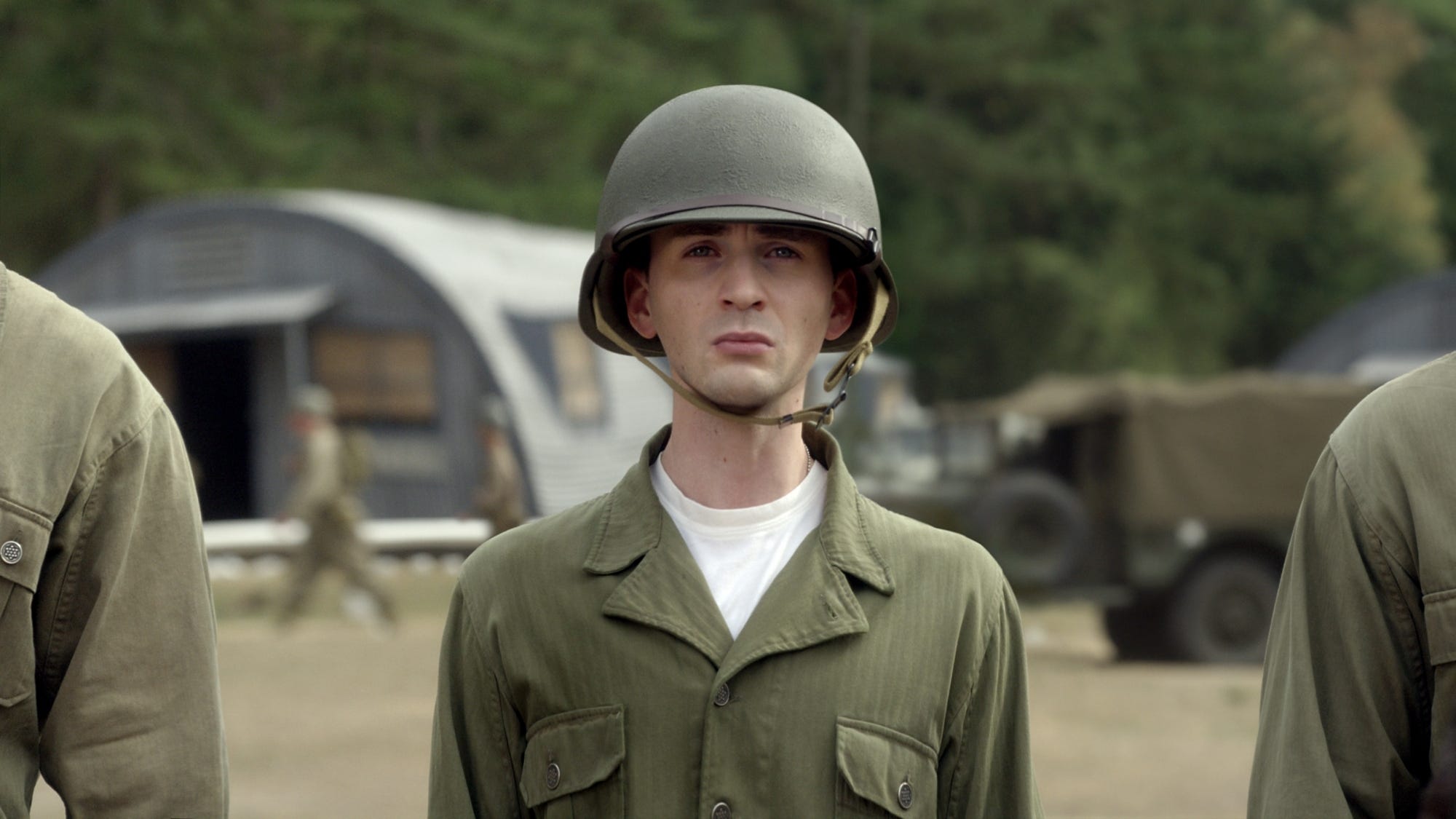
Dawn Raffel memorialized the American form of eugenics which the Nazis would later use in The Strange Case of Dr. Martin Couney, proving that Americans in this era believed that Rogers and his “kind” would “drag down the whole human race.” Rogers is naturally weak, and according to the eugenicists, the human race needs what Schmidt calls a “superior man” if it is to progress into the future.
First Avenger sets the atmosphere well; 1940 was when Joe Simon and Jack “King” Kirby created Captain America/Steve Rogers for Timely Comics as a war-time propaganda tool. “Cap” enjoyed immediate success upon publication, success that lasted throughout the war, but he faded from the newsstands once his purpose as a propaganda piece was fulfilled. When Timely became Atlas Comics in the 1950s, writer Stan Lee made an effort to revive Cap as “The Commie Smasher,” but this attempt failed abysmally. Only in Avengers #4 (March 1964) was a determined Stan Lee finally able to reinstall Steve Rogers in the public consciousness.
Why did the attempt to reintroduce Cap as “The Commie Smasher” fail? Simple. As Professor Geek said here on YouTube, Cap was no longer a propaganda piece. He had grown beyond that service, a fact Stan ultimately realized and then acted upon. The 2011 movie was successful because it streamlined and synthesized decades of comic book stories to satisfy longtime fans while at the same time introducing a new generation to the character of Steve Rogers, whom Stan Lee sought to bring back as an emblem of the “shining city on a hill” ideal.
A Star Comes to Earth
Why did Marvel preserve Captain America/Steve Rogers as a World War II veteran? Wouldn’t a Global War on Terror (GWOT) veteran work just as well? Actually no, a GWOT veteran would not work as well in the role of Steve Rogers. Anyone can be Captain America and in fact, several characters have borne the title at different periods in Marvel’s history. But each one of them has eventually surrendered the title, suit, and iconic shield back to their original owner: Steve Rogers. Every single replacement has “done their time,” and then returned to their initial positions (those that didn’t die and stay dead, anyway). The title of Captain America is not the deciding factor. Rather, the man who bears the shield is.
A word deserves to be said about the Johann Schmidt/Red Skull, the movie’s villain. Originally a protege and admirer of Hitler in the comics, in the 2011 film the Red Skull becomes something far more universal and deadly. His operation in Norway to retrieve a relic of the Asgardian gods (whom audiences saw two months before in Marvel’s Thor film) is not sanctioned by the Third Reich. In fact, Schmidt murders envoys from Hitler when they discover he intends to wipe out every capital in Europe – including Berlin. While Schmidt is presented as a fanatical Nazi in the comics, in First Avenger, the Red Skull goes even further and seeks to be a god among men.
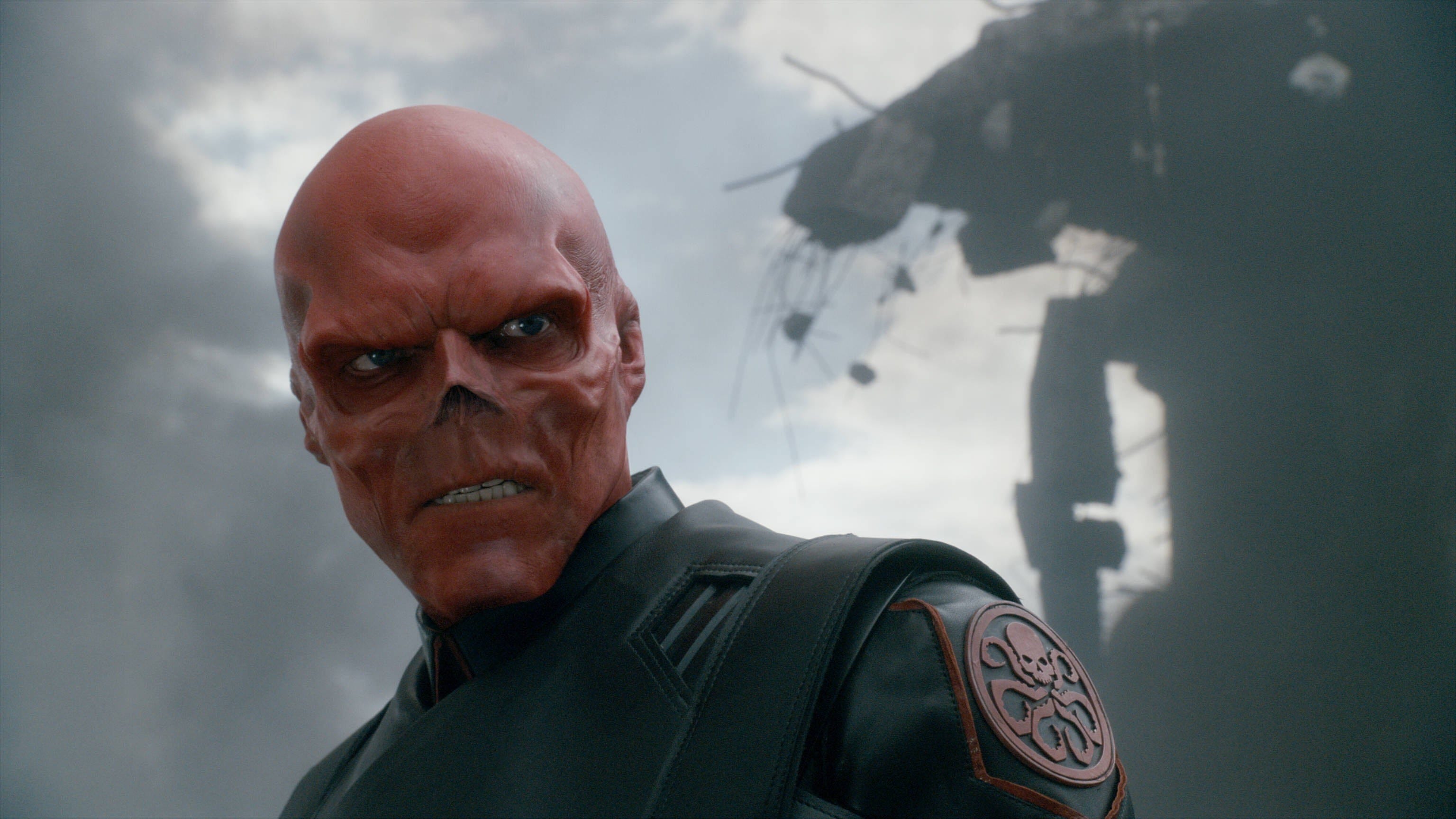
Schmidt does not seek a thousand year Reich nor a dynasty; such dreams are the desires of fragile, mortal men. As Colonel Chester Philips (Tommy Lee Jones) puts it, the Red Skull believes he is a god and he is willing to destroy the world to prove it. The movie no longer pits Captain America against Hitler and his Nazis, though it nods respectfully to the early origins for his character. Instead it sends Steve Rogers as a knight to battle the ultimate dragon, positioning him as St. George in a fight to the death against the HYDRA.
But first it must give him a body capable of fighting a dragon and surviving. This is where Dr. Abraham Erskine (Stanley Tucci) enters the movie. Erskine provides Steve not with a sword from a lake, but with a mysterious “scientific” serum capable of turning him into a super soldier: a man at the peak of physical perfection, capable of performing feats that no mere mortal can accomplish. But as Erskine notes, that is not even the most important part of the formula.
“Not a perfect soldier but a good man.”
Erskine’s admonition to Steve rings throughout the film. Philips states that America will win the War not because they have the best tanks or weapons, but because they have the “best” men. World War II is the last time in living memory that the United States breathed and fought as one united nation with a single purpose. No one doubted that the Nazis were evil, as some doubted the wickedness of the Soviets during the Cold War. The fact that Nazism and Communism differed only cosmetically was practically ignored by the very people who were so apt to originally denounce Nazism.
This means that Steve is fighting an unquestionably pure battle in World War II, one further refined by making his opponent something even worse than a mere Nazi. A deleted scene shows HYDRA troops killing German soldiers before capturing Bucky Barnes (Sebastian Stan) and the rest of the men who will later become the Howling Commandos or “Knights of the Round Table.” The Red Skull is a man who has bargained with demons to gain godhood, and he stretches out his hand to make the whole world worship him.
Empowered to bring about a Camelot-style dream of freedom for the “shining city on a hill,” Steve Rogers adopts the moniker given him for political expediency and turns it into a star which others will naturally aspire to follow. He rises as a saint, wielding a shield – a tool of defense – rather than a sword. Schmidt believes that Rogers comes as a conqueror when the two confront each other in the film’s climactic battle, but he is wrong. Steve displays meekness, like the Master he follows, stepping into the Christ-like role America has always longed to fulfill in the world.
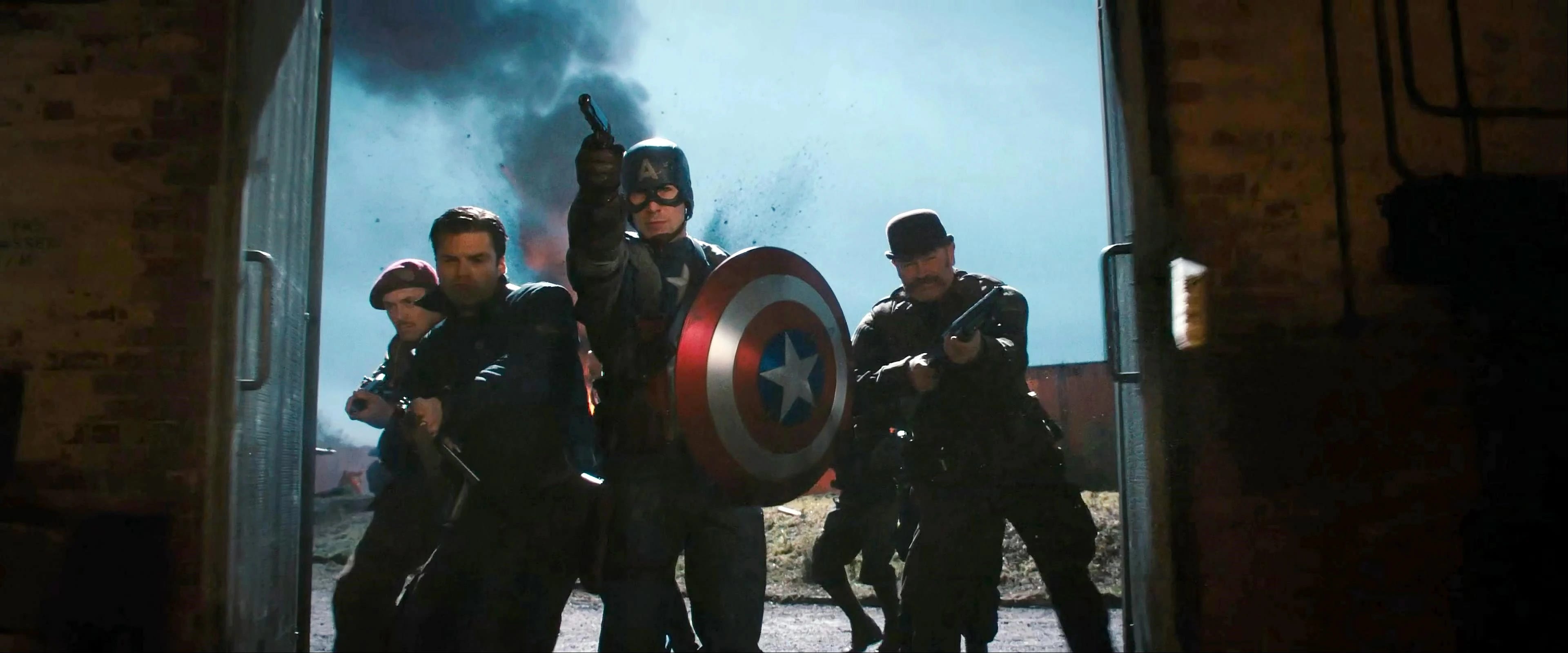
But to be a Christ-like figure means one must embrace sacrifice. Camelot fell because Arthur ultimately sinned and thereby failed; Steve Rogers falls, but he does not fail. He saves the world at his own expense, disappearing into the ice because he will not shirk his duty in this, the last extreme. In the end it costs him a life and a love with Peggy Carter (Hayley Atwell). Like Camelot, it seems to fall, lost with the star that plunges into the ice…but it is only buried, not lost.
The Return
Hic jacit Arthurus Rex quondom Rexque futurus. Steve Rogers, not Captain America, awakes in what appears to be a World War II era hospital room. It does not take him long to realize he is not where his “nurse” claims he is, but even he is not prepared to learn that he has been asleep for seventy years. Time has flown by, Camelot has fallen, and he must now move on in a world that seems to have no need of him.
The king wakes, and his country does need him – now more than ever. But will it accept him again? Or will he be remanded to the reliquary with all the other antiques? Forces stir in the dark, beyond human sight. The Captain must take up his shield once more if the world is to survive what comes next. But a single man cannot bring the dream of Camelot back on his own – he needs a Round Table.
He needs knights.
Photo Credits- The Movie DB, Wall Papercraft. com, and YouTube.
 | A guest post by
|