

Thank You for Voting(?)
Is voting a privilege that should be afforded to the worthy and the willing? Or instead, is it a universal right that should be made as easy as possible and even congratulated?

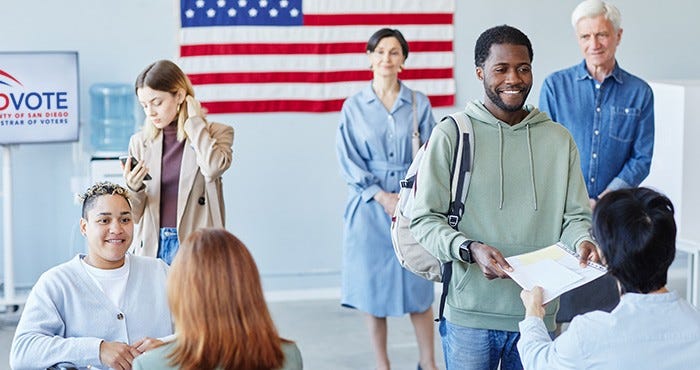
Every Election Day I work at my local poll. I do it for two reasons: to make sure there is no cheating and also to earn a little extra spending money. The work is routine and often quite boring. On the day of the election, workers are instructed not to speak with the voters, as doing so could be construed as meddling.
Election workers do break the silence, though, in order to thank people for “coming out and voting.” As the ballot is scanned and the “I voted” sticker is offered, one or more of the workers will thank each citizen who braved the 55-degree weather and all of the confusing ballot choices to make their voice heard.
But does this make sense? Should we thank people for doing their civic duty? Did they do something that is noteworthy enough to justify being thanked?
This article in intended to serve as a basic framework for considering our vocation as citizens: is voting a privilege that should be afforded to the worthy and the willing? Or, alternatively, is it a universal right that should be made as easy as possible and even congratulated? I can see both sides, but given some pretty basic facts, my view is much closer to the former rather than the latter.
Yes, I may be a crank, but shy of an above-and-beyond favor being performed, I don’t believe that people should be thanked for much of anything. Understanding that we all have duties, we should not expect that everyone else will thank us for doing what it is that we ought to do.
On the other hand, I don’t mean we shouldn’t say “Thank you.” We should…a lot. As a Christian, I am aware that being thankful and giving thanks to God is all over the Bible. Being an ingrate is corrosive to our souls and to our body politic so, by all means, we should express thanks both early and often. Manners such as these are like grease on the gears of the kind of polite society that I wish we could someday reclaim.
But as citizens, children, parents, church members, and spouses, we all have duties to perform, even more than we have benefits to enjoy. The creation and maintenance of civilization demands sacrifice and an attitude of public service. The hard work of raising families, building churches, volunteering for civic organizations, and being a good worker or business owner all require tremendous sacrifice. And without each of those vocations sacrificially giving of themselves to build and maintain our nation, we will lose what we call a “civilization” and end up in, at best, a mere commercial society that is defined only by the pursuit of money and power. If money is all that matters, then soon a majority will lose the will to sacrifice, and the system will eventually collapse under the weight of the takers, or as Ayn Rand has labeled them, the “moochers.”
So if a civilized society is to be maintained, our attitude and demeanor must be duty-oriented rather than benefit-taking. Therefore, we should not be thanked for doing that which we ought to do. Nor should we offer thanks for the kind of public act that voting simply is: the act of speaking our voice.
To thank someone for voting is to reward and encourage them for doing what they ought to have done in the first place. In my precinct I am certain that two-thirds of the voters are voting against my interests, but if I am honest with myself, while I would never deny someone’s right to vote, I am hopeful that one side votes less often than the other. And if the other side is being honest, I am sure that they are hoping for the same.
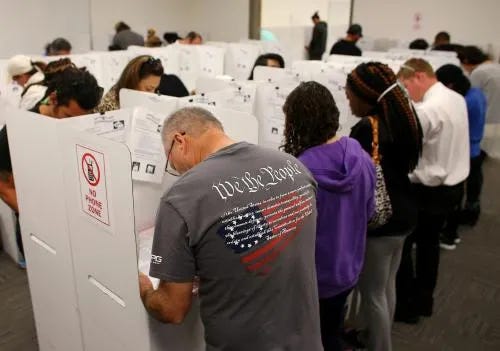
We need to be reminded that voting is absolutely not a universal right, illustrated by the fact that the Declaration clearly does not read, “life, liberty, voting, and the pursuit of happiness.” It is a privilege that should be afforded to a certain number of people. Should I make the cut? I don’t know. Ideas to restrict the voter pool have been floated ever since it has become obvious that the “takers” outweigh the “sacrificers,” and given that the takers seem to perpetually vote for more and more sacrifices (just not from themselves or their own pockets).
Perhaps the requirement should be that you need to be a “net taxpayer” to vote. Maybe you should be required to pass a civics test. Maybe you have to give a few years of public service, like serving in the military or a domestic version of the Peace Corps. Maybe you must refuse any form of welfare. Perhaps the measurement would not be done annually, but over the course of one’s life. So, a soldier, for example, should always have the right to vote even if they later become poor and are no longer a net positive taxpayer.
I don’t know what the guidelines should be, but I do know that it is grossly unjust for one person to be able to vote for the government to take money from me and give it to someone else. Yes, you can’t destroy all self-interest from voting, but to me seems a bit much to allow near universal suffrage in a nation that can’t even teach people to read.
In any sane world, not only would those who take more than they give not be thanked for voting, they would be prohibited from voting. But in a world where privileges are rights and we are entitled to that which we did not earn, we end up thanking people for the act of placing a vote.
In a world having such a twisted mindset, of course we do.
Photo Credit- Registrar of Voters and Brookings Institute.
 | A guest post by
|