

Stop Complaining About Inflation, Unless...
Amid the squabbles between President Trump, the Federal Reserve and the Legacy Media trying paint the economy in the worst light, is the grim truth about inflation, which many of us are complicit in.

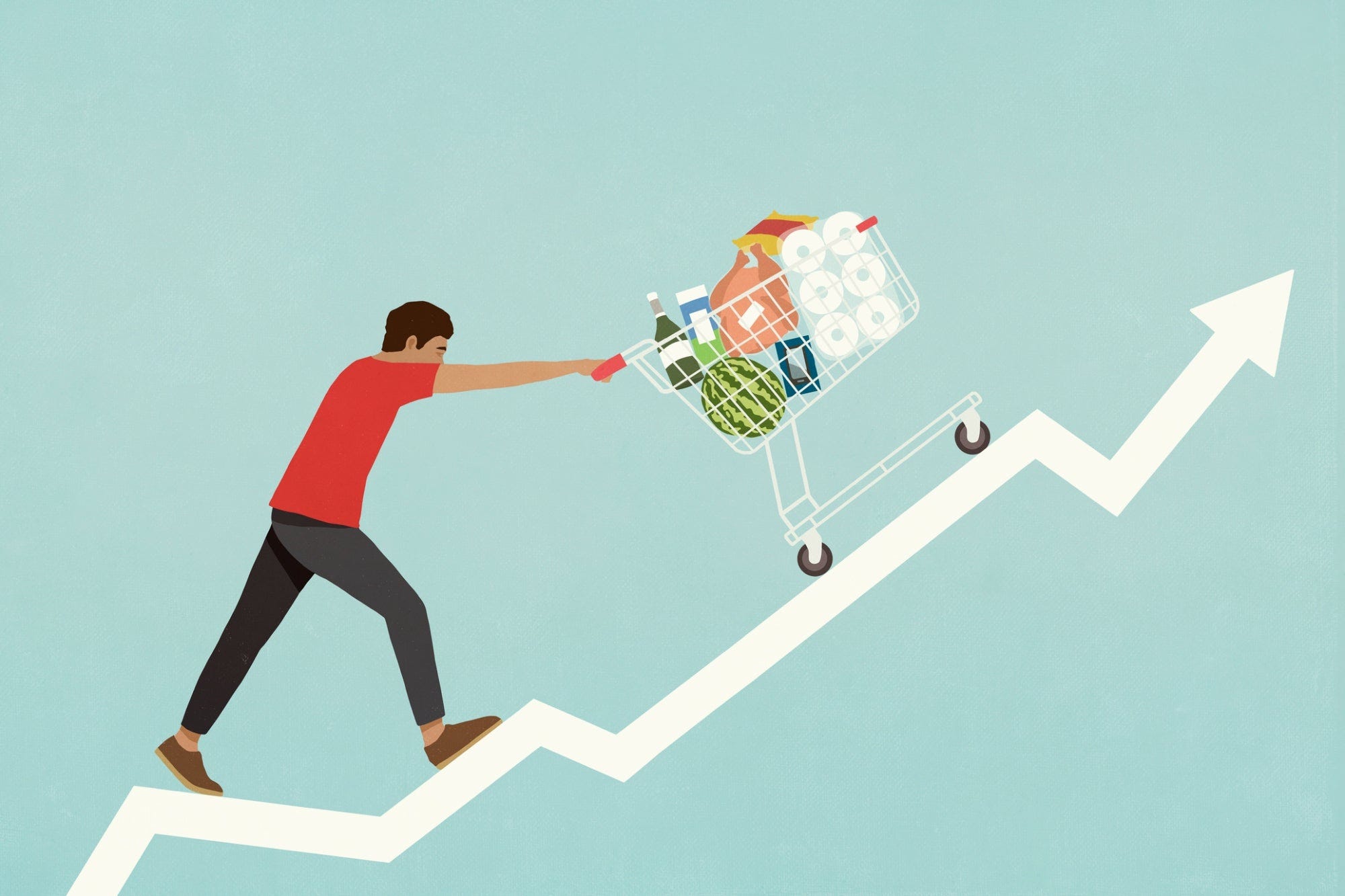
We all hate inflation. But have you considered whether inflation is better than the alternative? What if inflation is just the price we pay for easy access to money; money we use to buy homes, cars, and groceries on credit? What if inflation is merely the tax we pay for near-endless economic expansion, and that, while reducing inflation might keep prices stable, such a reduction might also stagnate future investment?
These are the kinds of tradeoffs we need to consider. But first let’s define a few terms. If we use the standard definition of inflation as “too many dollars chasing too few goods,” then it should be obvious that the creation of dollars has a major, if not a singular, role in causing inflation. In other words, inflation is not merely an increase in prices. In fact, the rise of prices is actually a symptom of inflation. Quite simply, inflation itself is caused by “too many dollars” in the economy.
American Economics 101
To begin we must first ask: where do these dollars come from? In short, they come from a central bank; a central bank that doesn’t actually “have” actual money (i.e., there is no “central” bank somewhere with piles of gold who benevolently decide to “lend” us some when we run out). Rather, they have just enough to act as a guarantor of what they give to local banks. But to be clear, the “money” doesn’t actually exist; it essentially comes to our banks, and later to us, out of thin air.
Because of a practice known as fractional reserve banking, banks can legally loan out far more money than they possess. The more money a bank has in deposits, the more money it can lend out, usually at a 10 to 1 ratio (though, since March, 2020 American banks are not even limited to that anymore!). So, if a bank has $1 million of customer’s money on deposit, it could (in pre-2020 days) lend as much as $10 million (in dollars that it doesn’t even have.)
So long as we all stay calm and don’t engage in bank runs, the emperor has no clothes (and no cash in the vaults)…but apparently no one really cares. Even though we know the bank doesn’t actually have the money, we all pretend the mortgage they give us is as real as a brick of gold. So our economy hums right along as we buy homes, invest in business, purchase cars, and enjoy the good life with money that, in all actuality, doesn’t exist.
It is true that the cash will soon exist, because the real money we are paid for our labor will be used to pay the bank back with interest for the “money” they lent us. With that real money now counted as a “deposit,” their base grows and so, too, does their lending power. It’s a really good deal for the banks: they create money out of thin air, act like they are doing us a favor, then we pay them back with real money that was earned from our labors, and with interest no less.
Now, this kind of phoniness can (and already has before) come crashing down to earth. But we are told not to worry; we have the FDIC and the Federal Reserve as a backstop. Your money—up to $250,000—is insured by the taxpayers via the government. After all, where do you think the FDIC gets its money from? Bank fees do not come close to accounting for what would ultimately be required if, say, Bank of America failed or the savings or investments of people who have saved more than $250,000 (as in the case the banks involved in the FTX cryptocurrency scheme).
When our government spends beyond its means, it either borrows money from other nations, or it essentially “prints” new money (the total amount of money isn’t technically “printed;” the government just runs up its IOU to the Federal Reserve). It’s an insane system which, like our nation’s unfunded liabilities, is ultimately doomed to fail. But in the meantime…
We have economic expansion! (or so we are told). If you have a small business, home, car, or have taken a cruise vacation, and you didn’t pay for those joys with silver bullion, then rest assured you have participated in this scheme. This fiction continues on as our government continues to spend far more than it takes in, and “prints’ money to offset the deficit, inflation being the inevitable result.
In other words, inflation is the price you pay for easy access to money.
Moving Towards a More Wholesome Fiscal Policy
What’s the alternative? Immediately, some version of a “gold standard” comes to mind. But it is important to appreciate that there isn’t enough gold on earth to account for the economic expansion of the past century. Every nation on earth is now has a fiat currency. Even if a gold standard were reintroduced, the money supply would be slowed by access to gold and/or the discovery of gold. Compared to the levels of spending we have been used to, the economy would come crashing to a halt. There simply would not be enough real money to create, purchase, or invest. Instead, as a consequence, we would see rampant deflation. What good are low prices if no one can afford to pay them?
The world would likely be more stable with a gold standard, but perhaps less advanced. I’m not saying we would currently be in something like the Middle Ages, but in such an alternate timeline, if we never left the gold standard, might the 2020s now look more like the 1990s? Would tech have been able to soar based solely on future valuations? Would housing prices or college tuitions not have soared in the past two decades?
The point is that if you want to go to a bank and get a loan, it is true that money has to come from somewhere. Instead, it actually comes from nowhere, but it’s real enough for you on closing day. So we all play along. The cost of the creation of money is “too many dollars,” which in turn creates inflation. So our bacon is $5/pound and not $2.50/pound. But you did get that car loan. I don’t like higher prices either, but unless and until we get back to real money and pay the actual price for “real money,” inflation is simply the tax we will be required to pay.
I guess you can’t have it all. I’m okay with slower growth, slower change, and real money, even if that means every consumeristic fantasy won’t come true. But is America okay with that? Obviously not. So expect inflation for the foreseeable future…until the inevitable crash eventually makes all things right again.
To be clear, I am not defending the current system, which seems doomed for collapse. In the meantime, we should at least elect politicians who will reign in wasteful spending, shut down all unconstitutional programs, and allow citizens to succeed in life (or fail without endless bailouts). But until we will do that relatively small job, we should stop complaining about inflation. Because easy access to money also has its benefits.
Photo Credit- Entrepreneur
 | A guest post by
|
Actually the 90s weren’t that bad.
Remember, war is always financed by fiat money.
There is too much JUNK and harmful spending, especially by governments. Examples are chemical spraying to “block the sun,” compressing CO2 underground, and voting computer systems. (We CAN hold elections with pencil & paper, and trust them more, to boot. ) Many “advancements“ are harmful. But you make a good explanation.