

Mr. Trump's Quiet Herem
President Trump's comments about rebuilding Gaza and the hostages recently released by Hamas, highlight his willingness to fix the Palestinian problem- with or without them.

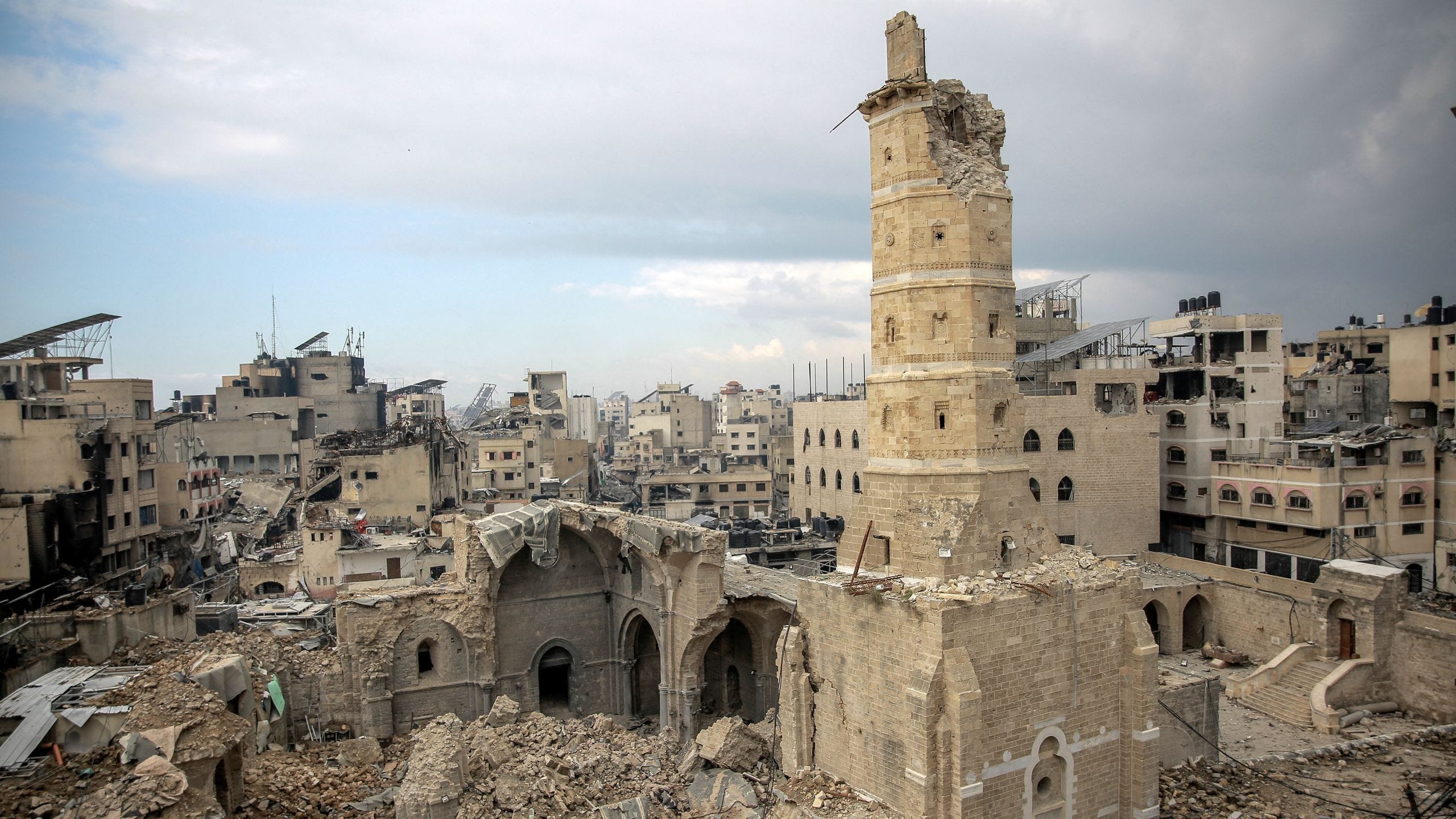
While most of the recent news has been focused on President Trump’s and Elon Musk’s efforts with DOGE to clean up Washington, events in the Israel-Gaza war have been quiet as a cease-fire is currently underway. However, two apparently unrelated incidents concerning the conflict have occurred recently, both of which highlight the nature of the conflict, as well as the nature of any future path for peace.
Trump the Builder Makes a Proposal
The first event happened on February 4 during a press conference with President Trump and Israeli Prime Minister Benjamin Nentanyahu. While answering questions about possible plans for Gaza and Palestinian refugees, Trump made the rather startling comment that, “The U.S. will take over the Gaza strip and we will do a good job with it too,” and that, “We’ll own it.” He went onto explain how the U.S. would be willing to clean up the place and dispose of all the unexploded ordinances on the ground, before introducing the idea of developing the place into a kind of “Riviera of the Middle East” where people from all over the world can live, work and prosper.
Netanyahu, who must have been stunned to hear such an outside the box solution to a post-war Gaza, was for the idea and replied that, “I think it’s something that could change history and I think it is worth pursuing this avenue.” Ran Bar-Yoshafat, an attorney and public diplomacy expert and member of the IDF reserves said that he thinks the idea is a good one as, “Israel left Gaza, but Gaza never left Israel” and that its radical Palestinian population will remain a problem to peace unless President Trump can broker a deal to resettle the Palestinians elsewhere, with the help of other Arab nations in the region.
Of course many countries around the world, including certain U.S. allies, as well the usual suspects within the left-wing government, educational and media establishment, were adamantly opposed to Trump’s plan. Nations such as Saudi Arab, Jordan, and European allies such as France, denounced the proposal out of hand as offensive, and clamored on from their respective countries that all appear to continue to support the long-standing (and utterly failed) call for a two-state peace resolution.
Never Again, Happened Again
The second event that happened in the Middle East occurred last weekend when Hamas released three hostages as part of the current cease-fire deal with Israel. All three, Or Levy, 34, Eli Sharabi, 52, and Ohad Ben Ami, 56, are Israeli citizens and all three endured fifteen months of imprisonment. The first thing noticeable to those viewing their release was how emaciated they looked. In an interview, President Trump observed that they looked like, “Holocaust survivors” and that they were “in horrible condition” and showed clear signs of mistreatment. As The Times of Israel reported, the hostages are reported to have been, “chained, gagged, burned with a searing hot object, hung by the feet and starved.”
Aside from the physical torture they endured, they also had to come to grips with the emotional trauma of the loss of loved ones. Or Levy had just arrived at the Nova Music Festival on October 7th when Hamas attacked and killed his wife. Eli Sharabi was separated from his wife and two daughters on October 7th, and upon his release he was informed that all three of them had been killed by Hamas.
As of right now there are still 73 hostages being held by Hamas, 34 of whom Israel has confirmed are dead. Hamas has said that it will suspend the next scheduled hostage releases as a reaction to what they perceive as Israel violating the terms of the cease-fire. President Trump has grown weary of Hamas and has declared that if all the remaining hostages (including six Americans) are not released by February 15th then, “Let all hell break out.”
Putting the Ban on Hamas and their Supporters
As has been made abundantly clear from his first few weeks in office, President Trump is not the same man he was in 2016. He certainly has a more seasoned outlook on his duties, as well as his handling of those opposed to them, and is acting accordingly. However, his tendency to speak in overly optimistic and patriotic superlatives, continues to engender a level of consternation among his critics who cannot (or will not) discern the difference between taking him seriously versus taking him literally.
Hence when it comes to his comments about Gaza, his intentions appeared to be more of a “big ask” strategy with which to ping his critics into revealing their political motives, as well as to invite them to share what they are (or are not) willing to do about it. A strategy that has already worked with Egypt offering to fund the rebuilding of Gaza and Jordan agreeing to accept some Palestinian refugees.
Furthermore, while he has surrounded himself with shrewd advisors, Trump is still the same pragmatic and transactional dealmaking D.C. outsider, whose political principals are more instinctual than intellectual. This is why his comments about rebuilding Gaza caught his critics off guard, since it was so far outside the box of the prevailing conventional wisdom concerning the Israeli-Palestinian conflict. As the Daily Wire’s Ben Shapiro noted, “All of the conventional wisdom, all of the State Department approved conventional wisdom, has for decades led to full-scale disaster in the Middle East, to an intractable multi-decade problem of a radicalized Palestinian population that supports terrorism rather than any regime that would allow for peace, prosperity and a livable life.”
President Trump’s willingness to think outside of the conventional wisdom of the “Oslo Accords” is what enabled him to push through the Abraham Accords during his first administration, which sidestepped the faithless two-state solution (which most world leaders realize is a polite fiction which they must continue to peddle in order to remain respectable among their peers).
When you pair that (apparent) strategy with his comments about the released hostages and his simmering ire over Hamas’ unwillingness to release the remaining hostages, Trump’s comments about taking over and rebuilding Gaza amount to what I would call a quiet herem. Herem is a Biblical term (introduced in Duet 20:17) which denotes a call by God to put certain peoples (such as the Canaanites), places (the city of Jericho), or things (idols and altars) under a ban, which ultimately means that they are to be destroyed. In this case, Trump appears to be making an almost backhand slap to Hamas and the Palestinians who voted them in, and who according to polls, still support them.
He is stating in no uncertain terms that he is willing to broker a deal concerning Gaza’s future, but only if the peoples and ideologies that have created and maintained a culture of conflict in the area are militarily destroyed or politically banned (herem) from the process. And why shouldn’t they be? For almost eighty years the Palestinians have been given multiple chances at forming a state of their own, and they have rejected them all. They have passed themselves off to the world as perennial victims, and they have even been given their own UN agency which works according to a definition of “refugee” that is applied to no other people, and have received massive amounts of foreign aid over the course of decades. This aid is in the form of money, which has been siphoned off to private bank accounts, food that has been stolen by Hamas, and humanitarian materials that were instead used to build weapons and underground tunnels. Moreover, other Muslim nations have consistently banned them from settling in their own countries because of their violence and radicalization, which they fear would infect/disrupt their own nations.
Whether it is polite to say or not, the Palestinians appear to be a cursed people, whose violent ideology has cursed their relationships with their neighbors. No lasting peace will ever be realized until they desire to live and prosper as a people, as plenty of Muslims around the world do. Thus, until they give up their radical ideology, if a herem upon the Hamas and the Palestinians is good enough for other Muslim nations, then it should be good enough for Mr. Trump.
Photo Credit- AD Middle East
John Zmirak had an interesting article hitting on the same problem of what to do with Palestinians in Gaza. It’s seems unfeasible to just leave them there but it’s also a mistake to keep them contained there to live out their days in radicalized squalor. He proposed sending them up the coast to the other Palestinian territory and let the Palestinian authority deal with them.
I’m kinda wondering though why Israel hasn’t annihilated Hamas by now. Is it really the possibility of civilian casualties and not recovering kidnapped victims? I don’t get it.
While growing up in the 60's and 70's, I constantly heard that Israel was the reason for continuous strife in the Middle East. Then came the Iran-Iraq War and killed that nonsense for most people. Unfortunately many others never learned that lesson and some have forgot it. Then it was land for the Palestinians in exchange for peace. That did not fix the problem and some still have not learned. Whether or not you like Israel, the other side has shown itself to be anything but civilized and not compatible with the rest of the world. They are their own worst enemy and treating them with kid gloves will not work - as has been shown time after time for well over 40 years.