

More Summer Reading Recommendations but from Authors Themselves!
When it comes to offering Summer reading recommendations, who better to ask than some authors themselves. We reached out to some writers at Upstream Reviews for some suggestions.



We recently ran an article where we asked our staff here at The Everyman to share some their favorite books titles for some Summer reading recommendations. Some of those recommendations came from Caroline Furlong, who has been writing for the Everyman since its beginning. However, she is also an published science-fiction and fantasy author with more than a dozen short stories and novellas to here name, as well as a prolific blogger and book reviewer.
Aside from her personal blog, many of her book reviews can be found at a site called Upstream Reviews. Upstream Reviews was founded by author Declan Finn who has been publishing horror, urban fantasy, thrillers and some nonfiction for the last fourteen years and has over 40 titles under his belt. According to Finn, the impetus to creating the site grew out of his frustration of “listening to ‘conservative influencers’ loudly proclaiming that ‘There is no such thing as right-wing art, but buy my book about it,’ when I had known dozens of really good right-wing authors for over a decade.”
He approached numerous websites and news outlets, especially those sites that were fond of saying how “Politics is downstream from culture” in order to “discuss the culture war” and to ask “why they didn’t review fiction.” For his efforts he received two responses, “I was ignored, or I was told, ‘All fiction is trash, and we will not review it’.” Hence he created his own site to engage in the culture wars in the way he had always wanted to and chose the name Upstream Reviews, “because we’re upstream from politics.”
Five plus years later Upstream Reviews is going strong and is a great site to find “thoughtful, positive coverage of the best in conservative and neutral fiction—spanning indie gems to Baen bestsellers and the occasional timeless classic. In an era of rage-bait “culture warrior” takes, we focus exclusively on books we genuinely enjoy, prioritizing honest analysis, entertainment value, and storytelling craft over outrage.”
We reached out to Upstream Reviews and asked if some of their own writers and authors would be interested in offering up their own Summer reading recommendations for our readers. Additionally we are also including at few more titles that didn’t quite fit into our last article. We hope you enjoy the recommendations and more importantly, support these authors and Upstream Reviews. After all it is one thing to complain about the woke slop that teacher unions and library associations hold up as their “must reads” for yourself or your kids, but is another to seek out and support books and authors which are “upstream” from all that horrid hype.
Declan Finn
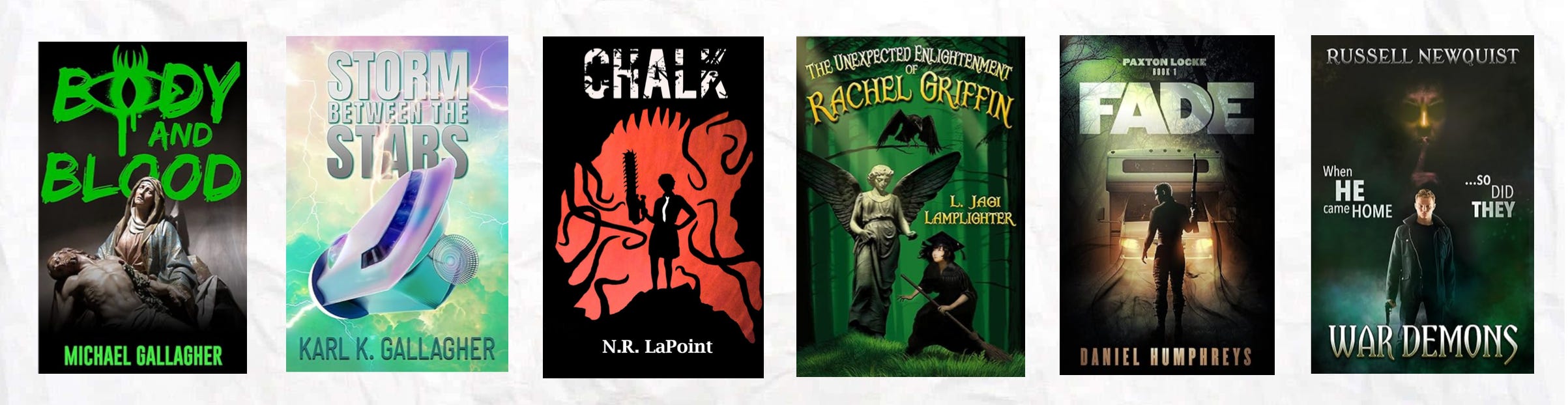
1. Body and Blood by Michael Gallagher
Father James Keenan heard a disturbance in the church, so he put on his Kevlar blazer and grabbed the pulse rifle. Instead of thieves after Sunday’s collection, he finds two literal ghouls trying to steal the consecrated hosts from the tabernacle. With the help of his 6’3” fellow priest and former pit fighter Akono Nwosou, the creatures are barely beaten back.
This is the opening scene of Michael Gallagher’s Body and Blood. A bounty has been placed on all things religious, and Keenan and Nwosou soon find themselves waging spiritual and literal warfare against a demonic street gang led by a witch in the Black Hollow projects. This war is going to be Hell on Earth.
The novel boasts a colorful cast: two badass priests, a parish secretary who looks like Janine from Ghostbusters (only armed. Seriously, do not mess with the parish secretary), a motorcycle gang that brings their Aabuelas to church, and an assassin-for-hire who makes dad jokes.
This is science fiction horror in a world so broken that four exorcisms a month is normal. The world-building is sparse but effective, keeping the fast-moving plot sharp. There are elements of body horror, child sacrifice, and lots of blood. If you like Tim Powers’ horror, Larry Correia’s action, or Jim Butcher’s world-building, you’ll love this. Body and Blood is a fun, entertaining romp that grabs you by the throat and doesn’t let go.
2. Storm Between the Stars by Karl Gallagher
Niko Landry is Captain of a family-owned freighter. Like all shipping companies, he makes deals based on what will sell better in X system over Y, never leaving his cargo hold empty. When Niko and his crew find themselves lost in space, they discover they are the first humans back in Earth’s galaxy after three thousand years of diaspora. Since the Landry family business is private, they don’t have to report anything. They are the first ones to find what new resources and technology may have been developed in the meantime.
But Earth and the associated systems are now ruled by “the Censor.” Karl unveils a system piece by piece that builds into 1984 or Fahrenheit 451 in space, ending with an interstellar space chase that David Weber would have been happy to write. Their only weapons? Space maneuvering and physics.
The characters are sketched out well. They appear to be simple stereotypes, but are much deeper. Karl does a good job developing a world with sane libertarian ideas, extended families, barter to get around taxes, and clever cultural elements. The politics vary between libertarian and social conservatism of the 1800s.
It’s as scary as 1984 should be. If you like physics in your science fiction, world-building like Frank Herbert, David Weber, or most Baen Books output, you’ll want to give this a shot. I definitely enjoyed it and recommend it.
3. Chalk by NR LaPoint
Think of any version of Alice in Wonderland gone truly weird — then add chainsaws, shotguns, lightsabers, and a velociraptor with miniguns. Chalk opens with Raven Mistcreek returning from Catholic school to find her house vanished and neighborhood dogs trying to kill her. A flying cuttlefish in a top hat tells her “Come with me if you want to live,” and things only get stranger from there.
Raven has no memory of her past, her family is missing, and Lovecraftian horrors are hunting her. She and her family hold the key to stopping the destruction of all creation. Thankfully, she’s not alone. She gains allies like a kitsune with a katana, a paladin with a lightsaber-blaster, and a golem. With her magic box of chalk, she draws weapons, from handguns to chainsaws, that come to life.
The pace is blisteringly fast, blending fantasy, mystery, and non-stop action. Raven is an awkward, relatable heroine who solves problems sideways rather than through raw power. The world is gloriously insane — Dante’s Inferno with shotguns, war-velociraptors, ghost minotaurs, war unicorns, and living Lovecraftian nightmares.
There’s no sex or profanity, and the violence stays in the realm of fun fantasy. If you enjoy Terry Pratchett, Tim Powers, or John C. Wright, you’ll love this inventive, action-packed ride. I finished it in three sittings and couldn’t wait for the next book.
3. The Unexpected Enlightenment of Rachel Griffin by L. Jagi Lamplighter
This has been described as Fringe meets Narnia in Hogwarts, and the Narnia is easy to see, and it is set at a magical school. But imagine the end of the Harry Potter series (the school is under full assault, things are blowing up, students are fighting, and great beasts are tramping around) as only the prologue. There’s a dragon, possession, hordes of the possessed, and even an evil math tutor (not named Moriarty).
Rachel Griffin is just starting at Roanoke Academy for the Sorcerous Arts. In a world that has been rewritten, only she can see through the machinations trying to hide what has been forgotten. Rachel wants to know everything, and that may get her killed and destroy reality along with it. The story is packed with mystery, subplots, and character arcs, yet Jagi makes it look effortless.
Rachel is English royalty in a new world with classmates from all over. Chief among them is Siegfried Smith, who comes with a Dickensian background. The world-building is far deeper and richer than Harry Potter, with a complete magical society that answers nearly every question.
This ends up as Christian Fiction, with Aslan-like elements, and everyone at the school open carries a sidearm. It’s clean YA done right. This book is awesome.
4. Fade by Daniel Humphreys
Did you ever wish there was more of Jim Butcher’s The Dresden Files? A likeable, witty hero with magic, snark, and the ability to take a beating? Meet Daniel Humphreys and his hero, Paxton Locke.
Paxton Locke has had a tough life. That’s what happens when his mother sacrificed his father in a demonic ritual and tried to add Paxton himself to the mix. Now Paxton makes his living as a paranormal investigator ridding homes of ghosts. When a ghost warns him of impending doom, he has to return home to face his worst fears.
This is not a Dresden knockoff but a true successor. Paxton is a snarky first-person narrator who uses quips, media references, and guns. The author is a smartass, too. The first client is a woman named Shirley Jackson, whose house is on a haunted hill top, and his evil mother is an adjunct professor of cuneiform studies and an evil vegan.
I like the magic system — it has a real, visible cost. Ghosts are echoes of pain and suffering, and the grimoire has a personality of its own. The ending is a wonderful setup for book two with bigger stakes.
This is for any fan of Urban Fantasy, whether Jim Butcher or Larry Correia. Fade is better than Storm Front or Fool Moon. When I finished it, I was ready and rearing to go on to book two.
5. War Demons by Russell Newquist
The Devil went down to Georgia. He was looking for a soul to steal.
And this time, he isn’t coming with a violin. He’s prepared for war.
Chapter one opens with a sword fight against a demon and ends with dropping a daisy cutter on it. Fast forward a few years, and Michael Alexander is back in Georgia after a helicopter crash in the sandbox left him haunted by something colder and hungrier than the dark. When his dead buddy starts stalking him in the shadows, it’s clear these aren’t just PTSD demons.
The crazy quickly escalates, sucking in the entire state. Black ops commandos, Vatican operatives, a billionaire prepper, and a Magnificent sSeven–level crew mount up to save the damsel from the dragon. Then things get worse. The villain is so deliciously evil you’ll want to stake it, cut off its head, and burn the body.
War Demons delivers solid characters established early, plenty of backstories, and a sharp sense of humor. It’s our world with monsters lurking in the background — just enough world-building to keep the action roaring. Expect golems, vampires, zombies, warlocks, and jihadis. The finale includes Blackhawks and Apache helicopters fighting a dragon before ending, naturally, at a Georgia football stadium.
This is Jim Butcher’s Harry Dresden slamming into Larry Correia’s Monster Hunter International, with a strong lean toward MHI and “Punch you in the face Catholicism.” It’s everyday people fighting the forces of darkness with enough firepower to make the A-Team jealous. Pure fun.
Graham Bradley
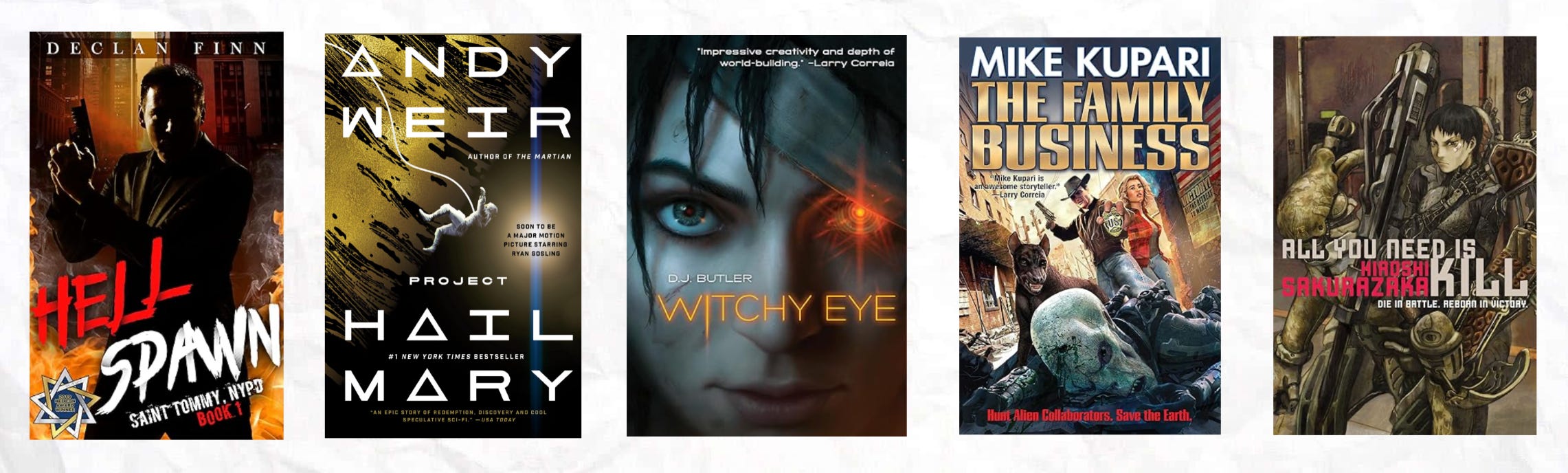
1. Hell Spawn by Declan Finn
For the last couple of years, anyone who’s been in Declan Finn’s social media orbit has definitely seen his promo posts about his Saint Tommy NYPD series. I always summed up Declan’s series as “Catholic Dresden Files.” Now that I’ve finally gotten around to reading the first entry, I can confidently say that description fits.
An evil spirit is hopping around and inhabiting different hosts in Queens, New York. Tommy Nolan encounters this spirit, and as he interacts with it, certain new abilities manifest within him that help him meet the threat. Before he gets to the end, his wife and son face mortal danger, his house is haunted, and bodies start piling up. Once Tommy recognizes the killer’s M.O. matches that of an Old Testament demon, things get very hairy. Declan Finn definitely goes there, showing the work of demons in the real world.
Saint Tommy is an action hero that Christianity in general—and Catholicism in particular—can really sink its teeth into. I saw something I could admire in Detective Nolan’s ironclad adherence to his faith.
The world is definitely ours, with spiritual explanations for much of what happens around us. The day-to-day machinery of New York policework feels authentic.
Who’s it for? Catholics specifically, Christians generally, and fans of urban fantasy or police procedurals. If you liked the Netflix Daredevil run, this is up your alley.
Because it’s really good and it’ll make you want to get into book 2. Good news, there are 12 of them out…so far. So go buy the first one and start catching up.
2. Project Hail Mary by Andy Weir
As Andy Weir continues to build his bibliography in the wake of THE MARTIAN, he makes an admirable effort with a new novel about a man stranded in space, trying to solve a world-ending problem.
A new solar phenomenon could spell disaster for the human race: a species of microscopic phage is eating our sun. Once humans convert the “astrophage” into a fuel source, they build the Hail Mary ship and send scientists on an interstellar voyage to find a cure.
Our protagonist is Rylan Grace, a PhD in biology and space sciences, who wakes up on the ship from a forced coma with retrograde amnesia. His other two crewmates died en route, so it’s just him out in space trying to remember why he’s there. We also have an alien that Rylan nicknames “Rocky,” who is a very interesting character.
This one skews more heavily toward the hard side of sci-fi. You can read it for the adventurous elements, but be prepared to drown in the hard science that Weir dished out in THE MARTIAN. Even the stuff he made up is heavily grounded in real science. Once Rocky shows up, it was hard to put it down.
The story is still exciting and the stakes are still high. This is the kind of book that entertains you while helping you to understand the forces that govern the cosmos.
3. Witchy Eye by D.J. Butler
Imagine an alternate America where arcane Appalachian magic and religious revivals grapple for converts. In the middle of it all, a teen girl learns the truth about her birth parents, that she’s the heir to an Eden-esque empire, and now she has to navigate treacherous political waters with new powers she doesn’t understand. Throw in a cast of varied and charismatic characters, and you have D.J. Butler’s Witchy War saga.
Sarah Calhoun is an Appalachee farmer who ends up pissing off the wrong guy, a New Light preacher who takes notice of her witchy eye. Soon she’s caught up in a struggle between factions, one that wants to control her and another that wants to restore her to her birthright on a throne in Eden.
Sarah sets off to find her siblings with the help of her nephew Calvin and Thalanes, a traveling monk. My personal favorite is the gentleman swordsman Sir William Johnston Lee, known as “Bad Bill.” The main baddie is the Right Reverend Father Ezekiel Angleton.
This is a North America that refers to familiar places by different names. Butler did his homework shaping it. The politics are in-world only. Nothing “Current Year.”
It’s an epic fantasy with the weight of biblical lore behind it. I’ve read WITCHY EYE three times. I think I’m ready for a fourth reading myself.
4. The Family Business by Mike Kupari
What happens in an alien invasion story after humanity wins, and we’re left to pick up the pieces of civilization? THE FAMILY BUSINESS puts us alongside a military veteran who makes his living hunting down pro-alien collaborators and bringing them to justice.
What made THE FAMILY BUSINESS cool was that it showed us the world a few years after the human victory, when our planet is trying to recover from population loss and damage to our infrastructure. Our protagonist, Nathan Foster, is a veteran of the war who believes in the system. When the Feds hire him to capture an escaped prisoner, he uses his wits and his contacts before he uses his guns.
Nathan’s business partner Stella keeps his paperwork in line, and his teen nephew Ben helps with tech. Then there’s Emmogene Anderson, a former collaborator experimented on by the Visitors, and Swiss super-commando Anthony Krieg, a diehard collaborator who wants to bring the Visitors back.
Kupari’s handling of a post-invasion Earth is utterly believable. A lot of developed countries are almost back up and running, they just need help from independent contractors. The action scenes were swift and the in-between stuff didn’t drag.
I was most impressed by how real it felt. This is my third foray into Kupari’s writing and his military experience always comes through strong.
5. All You Need Is Kill by Hiroshi Sakurazaka
Remember that Tom Cruise movie where he puts on a mech suit and fights aliens like it’s a video game, respawning every time he dies? Well, Edge of Tomorrow/Live, Die, Repeat was based on ALL YOU NEED IS KILL by Hiroshi Sakurazaka.
In the near future, Earth gets invaded by aliens called “mimics.” A new soldier named Keiji goes into his first battle only to die, wake up the next day in the past, and return to battle yet again. He is trapped in a time loop that sends him back 30 hours before the battle, dying painfully every time. It all changes when he meets Rita Vritaski, a legendary jacket jockey who has the exact same affliction.
Keiji is an everyman who becomes a hardened veteran determined to win. Rita is a fascinating enigma who stole an identity to fight back after mimics killed her family. Both characters are flawed yet heroic, relatable and aspirational.
Caroline Furlong
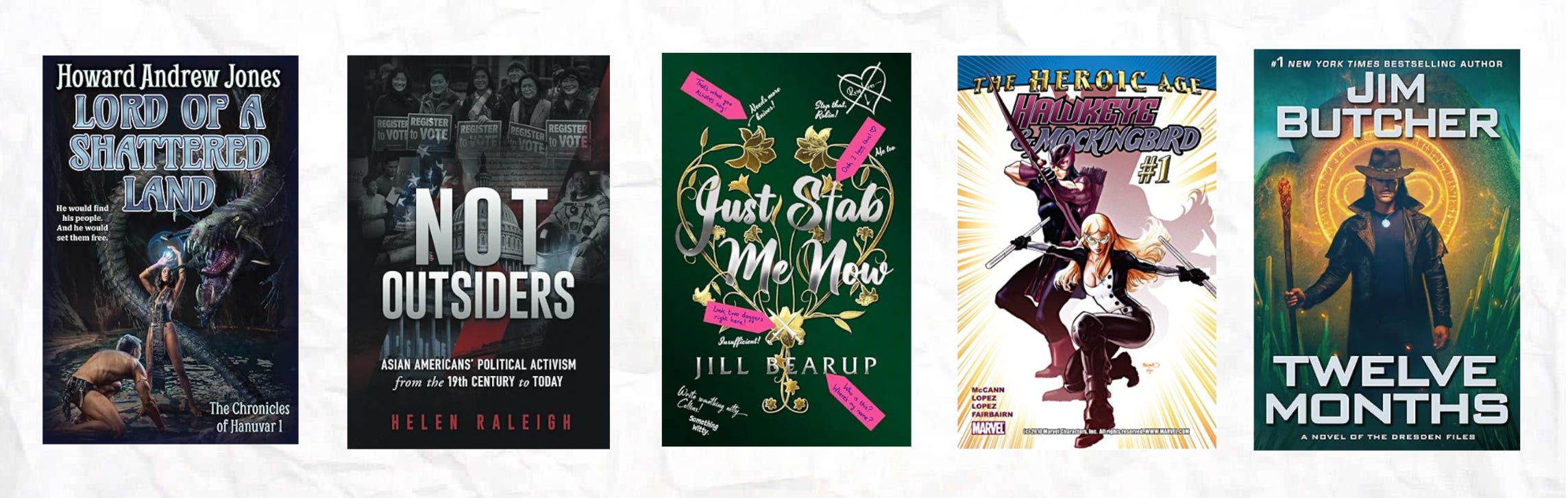
1. Lord of a Shattered Land by Howard Andrew Jones
Looking for some summer fun? Try Lord of a Shattered Land, where the Dervan Empire has conquered Volanus – a seaside city of silver towers, women warriors, able soldiers, and excellent sailors (plus two dragons). Thrice the city state of Volanus and the Dervan Empire warred, and thrice the Dervans won, this time sending Volanus’ top general to his death.
But Hanuvar Cabera is not dead yet. Held prisoner by the king of Narata, Hanuvar is promised freedom if he can command the dragon on the Naratan island to defend the kingdom from pirates. Hanuvar possesses no such power and he knows the king is lying about releasing him after he fulfills this task. One lie deserves another and Hanuvar uses the opportunity to escape – after repaying the king for his “hospitality.”
Only then does Hanuvar begin his mission. The Dervans razed Volanus and salted the fields, carrying off the remaining Volani as slaves – including Hanuvar’s daughter. He seeks to find those enslaved and bring them to a secret colony called New Volanus. Not everyone can be saved, however, and darkness stalks the land, seeking to remake the world in its own stark image….
2. Not Outsiders by Helen Raleigh
Last year I read and reviewed Helen Raleigh’s newest book, Not Outsiders, a view of Asian Americans’ contributions to U.S. history and various civil rights movements. From the arrival of Chinese and Japanese immigrants, to World War II era Nisei activism, and all the way to the present, her book gives a very good counterargument to the continuous drumbeat of racism in America. What racism there is has either been conquered or become negligible – at least outside the halls of academia.
Ms. Raleigh ends the book showing how colleges and universities have enforced an unspoken “Asian penalty” on applicants of Asian descent to make things “fair” for “disadvantaged” students. She documents its spread to California politics and the expanding discrimination throughout the country.
In addition to her historical expositions, the book is a worthwhile investment. There is so much history that is not taught, which Not Outsiders recovers. It will make for edifying reading indeed!
3. Just Stab Me Now by Jill Bearup
YouTubers are beating Hollywood hollow, but they are also writing great books. Jill Bearup is a “YouTuber, Actor combatant, and accidental author” who creates humorous videos breaking down how combat in fancy dresses would actually work and why fantasy armor looks pretty but is not actually useful. She made some funny interconnected YouTube shorts to tell a story where an authoress and her character kept getting into arguments over the validity of tactics and dresses, and the series was such a big hit she turned it into a book: Just Stab Me Now.
Authoress Caroline Lindley is trying to write an “Enemies to Lovers” story. Her main character, Lady Rosamund of Hawkhurst, is recently widowed and trying to protect her two children from her liege-lord’s predatory intent. Rosamund has no time and little patience with Caroline’s attempts to get her in bed with the guard the queen sends to protect her as she dispatches Rosamund on a peace mission. Can Rosamund save her family? Will Caroline get her happily ever after as well as a satisfactory story?
If you like The Princess Bride, grab Just Stab Me Now today and enjoy!
4. Hawkeye and Mockingbird: Ghosts #1-6 by Jim McCann and David Lopez
Before Marvel went woke and broke, a writer had a dream fulfilled. Jim McCann is a Hawkeye fan and it shows in the first issues of his series featuring the superhero known as Hawkeye, a.k.a. Clint Barton. The series also features his ex-wife in the “mainstream” Marvel universe, Mockingbird/Bobbi Morse, a character whose only film debut was in Agents of SHIELD. Ghosts #1-6 deals with ghosts from both these Avengers’, pasts but more so for Mockingbird, who does NOT want to face them!
Least of all does she want to face them with her ex-husband by her side. Clint is determined to win Bobbi back, but when old wounds reopen, will the two be driven further apart? Or will this reunite them at long last?
McCann wanted the series to end one way but the editors insisted it had to end another. But for a few golden issues, fans of Marvel’s famous “baseline human” couple could enjoy some classic Hawkeye and Mockingbird action. Anyone interested in comics should pick up and read Ghosts #1-6 at their earliest convenience!
5. The Dresden Files: Twelve Months by Jim Butcher
What do you do when your life falls apart? You build it back up, one grinding moment at a time. Harry Dresden’s life did more than fall apart in the Battle of Chicago. He lost the love of his life, his city is in ruins, and his older brother is slowly going mad while his vampiric Hunger eats him alive. Said brother’s pregnant girlfriend is possessed and missing, and thanks to Mab, the Queen of the Winter Court, Harry is affianced to the head of the White Vampire Court.
It is an engagement he cannot break for anyone’s sake. As rough as his life has been up to this point, it wouldn’t be a surprise if he just chose not to wake up one morning. Life’s hurt him enough already.
But Harry has people depending on him. He cannot afford to die. So he gets up and works through his routine to get his body back into shape, facing the grief each and every moment. Functional is not good enough. If he really intends to save everyone, he needs to be back on his feet – one workout, one item struck off the list, and one breakfast at a time. No matter how much it hurts.
Vincent Weaver
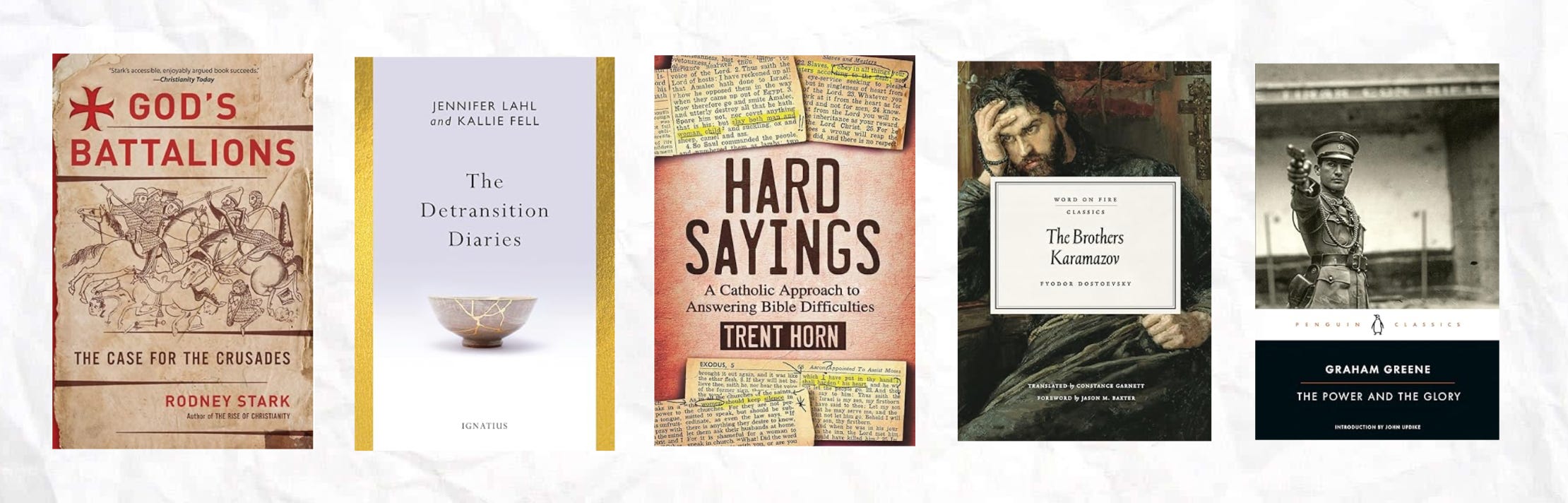
1. God’s Battalions: A Case for the Crusades by Rodney Stark
Excellent insight into the Crusades; shows the fallacy of nearly everything we “think” we know about them. Offers a coherent timeline and disputes commonly held understandings with specific, credible evidence as to why many of those things are wrong or not understood in the proper context. A must read for Catholics and would make for a great HS or college course or just a presentation.
2. The Detransition Diaries by Jennifer Lahl & Kallie Fell
Excellent resource on gender dysphoria – possibly the best I’ve run across; uses great analogies to help the reader better understand how bizarre the medical industry has become these days (e.g. The Tuskegee Experiment; lobotomies in the early 20th century, et. al.) Gut-wrenching testimonials given by 7 young men and women, along with damning evidence of gross malpractice by the medical community and public school system, at large.
3. Hard Sayings by Trent Horn
Rereading from a few years ago. An outstanding tool for viewing oddities from the Bible in a new light – a comprehensible light. The explanation of slavery as we misunderstand it in the 21st century was especially interesting. More research is needed on my part to shore up many of the lessons gleaned from this book. Should be of help to Protestants and Catholics alike when dealing with objections from atheists or non-Christians.
4. The Brothers Karamazov by Fyodor Dostoyevsky (Audiobook)
Listening to this on audiobook this time after having read it 5-ish years ago. Several people whom I respect consider this one of the greatest books ever, so I figured I needed to give it another shot. ‘Glad I did. The audio version did wonders to help me “get it”. Brilliant dialogue between characters exhibiting a wide range of morality. Truly penetrates the struggles and temptations mankind faces.
5. The Power and the Glory by Graham Greene
I’ve run across mention of Graham Greene (and this book, in particular) many times. Thought it was time to give it a shot. About a fictional, troubled priest in Mexico in the 1930s. French Revolution 2.0. I thoroughly enjoyed this book. Very powerful testimony of a very flawed man recognizing the Truth, Beauty, and Goodness of God and His Church. All that matters is becoming a Saint.
Photo Credits- Adobe Stock and Amazon.
 | A guest post by
|
 | A guest post by
|