

Bowling Alone
Bowling Alone is a 2000 book by Robert Putnam that laments America's decline in our participation in religious, civic and political institutions. Here is a commentary on the religious aspect of it.


This article was originally published in the Sin Boldly Blog
I am currently reading Bowling Alone, a book that has been on my “to read” list for years now. I am not yet done with the book, but the central thesis of the book is clear early on and anecdotally obvious. The thesis is that American civic participation has essentially cratered since its high point in the mid-1960s. Written in 2000 and recently updated, the book traces the downward trajectory of participation in church, civic clubs, fraternal organizations, trade unions, and voluntary political activity. The drop is both steep and universal.
I am not yet to the point in the book that outlines why this precipitous drop in participation has occurred or what we can do to reverse it, assuming we want to reverse it and we actually can. Written before the internet was ubiquitous, the lazy answer of social media and smartphones can’t account for our civic decline, though that has obviously not helped. Everything from suburban sprawl to the distrust of institutions to the rapid growth in personal wealth and autonomy have contributed to our isolation, and nothing less than a true desire and/or need to reconnect with our neighbors (and God!) will reverse the trend.
The author definitely mourns the decline and believes the trend can be reversed. After all, American life has seen similar ebbs and flows. And perhaps comparing current participation to the highs of the Baby Boomer’s upbringing is not fair. After all from 1945-1964, millions of children were going to school and church, optimism was at an all-time high, and technology had not yet isolated us. That was an artificially energetic and hopeful set of circumstances that could not last more than a generation. We are just living through our institutions becoming shells of what they once were, probably just reverting to the mean.
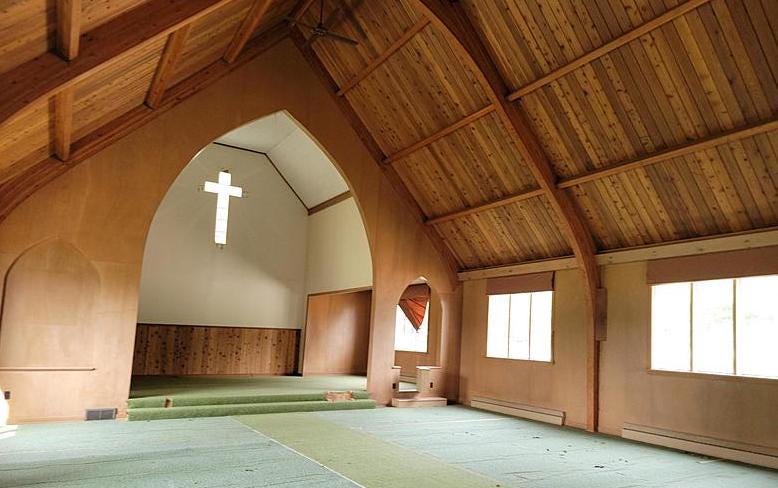
Churches, obviously, have suffered along with every other civic institution. Church attendance and participation has fallen (especially when compared to population growth) since 1965. America’s landscape is covered with sanctuaries build in the 1950s and 1960s for neighborhoods now full of middle-aged people who rarely go to church. Their architectural stylings, furniture, and musical instruments are stuck in a time warp when Americans still largely went to church.
So what happened in 1965 and might that hold any insight to the future? I believe the assassination of John F. Kennedy and our ensuing involvement in Vietnam were devastating morale blows to our nation. I happen to believe that Lyndon Johnson was involved in the assassination and we know that on November 26, 1963 he revoked President Kennedy’s Executive Order to begin pulling out of Vietnam. So, I lay a lot of our decline at the feet of a man who was deeply cynical, notoriously corrupt, and a political animal the likes of which our nation has rarely seen. More than any one person, LBJ drug our nation into his psychological cesspool, and we have never fully recovered.
Aside from just such political and social upheaval, Postmodern philosophy and all of its empty promises finally filtered down from the academy to the “street.” The average American teenager was not necessarily a drug user in 1970, but he was far more nihilistic than his 1960 counterpart. Nietzsche was misunderstood and misquoted as it became common knowledge that “God was dead” and the Church looked square compared to the emerging prevalence of “pop culture,” a virtual unknown before the 1960s.
But we can recover from our cynicism and civic decline if we believe that God can usher in a better world and if we have hopeful and visionary leadership. Civic institutions may never again see their heyday of the 1950s, but we can most definitely reverse the trend. And I believe we will.
The promises of secularism writ large have proven to be a lie. The sexual revolution has failed. The welfare state has failed. The stock market’s growth at the expense of Main Street has failed. Even Big Medicine has largely failed, as we die sooner than before. Eventually, there will be a questioning of conventional wisdom, as to why so much of what we have been promised has not come to pass. And the Church will be there waiting for them.
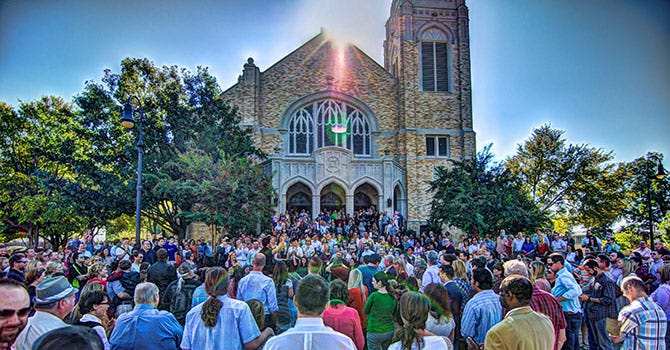
So, what is the job of the Church in 2025? To put it in a word, “retreat.” But that doesn’t mean to hide in a cave. As a wise pastor once said when he defended going on retreat as a “strategic withdrawal for the purpose of reengagement.” This is a period of retreat where we are growing leaner. We are reprioritizing what’s important. Our work is more focused, so we will be ready when Secularism has worn off and the world is ready for what Christ offers again.
Here are five non-essentials because I love lists as to what we should be doing now:
1. Remain orthodox. Liberal theology has killed churches faster than secularism, so obviously we want to avoid that.
2. Either use your building to generate income or have pastors prepare for tent-making ministry (making money with a side business.)
3. Build a homeschool library. There is a good chance local church schools and micro-schools/homeschools will be the schools of the future. Be ready to absorb those students.
4. Stop pandering. Put the guitars down and give the world a serious option other than Hollywood Lite. They think it’s lame.
5. Evangelize. Somewhere, somehow, we need to make ourselves publicly available, so when the curious want to return, they know someone to whom they can return.
When will the return to civic life happen? Well, Jesus says he will come like a thief in the night, so we should always be prepared. Seems like good advice for our more immediate concerns, too.
Photo Credit- Pacific Standard, Minnesota’s New Country & Faith and Leadership
 | A guest post by
|
I like your list at the end here, particularly the emergence of church-hosted micro-schools. Already, co-ops are happening at a lot of churches and the school choice bill that just passed in TX will really fuel this transition away from the public school monopoly.
I do think technology has played a large role in the dissolution of communities. Families will need to make a concerted effort to stay offline. This will change the whole dynamic and foster more socializing and connection. Perhaps church leaders could make this case. I’m surprised I don’t hear this argument more often.