

An Interstellar Parody
This Christmas marks the 25th Anniversary of the 1999's Galaxy Quest. The film is a comedy that aptly pokes fun at sci-fi films and television series like Star Trek, and is still worth watching today.

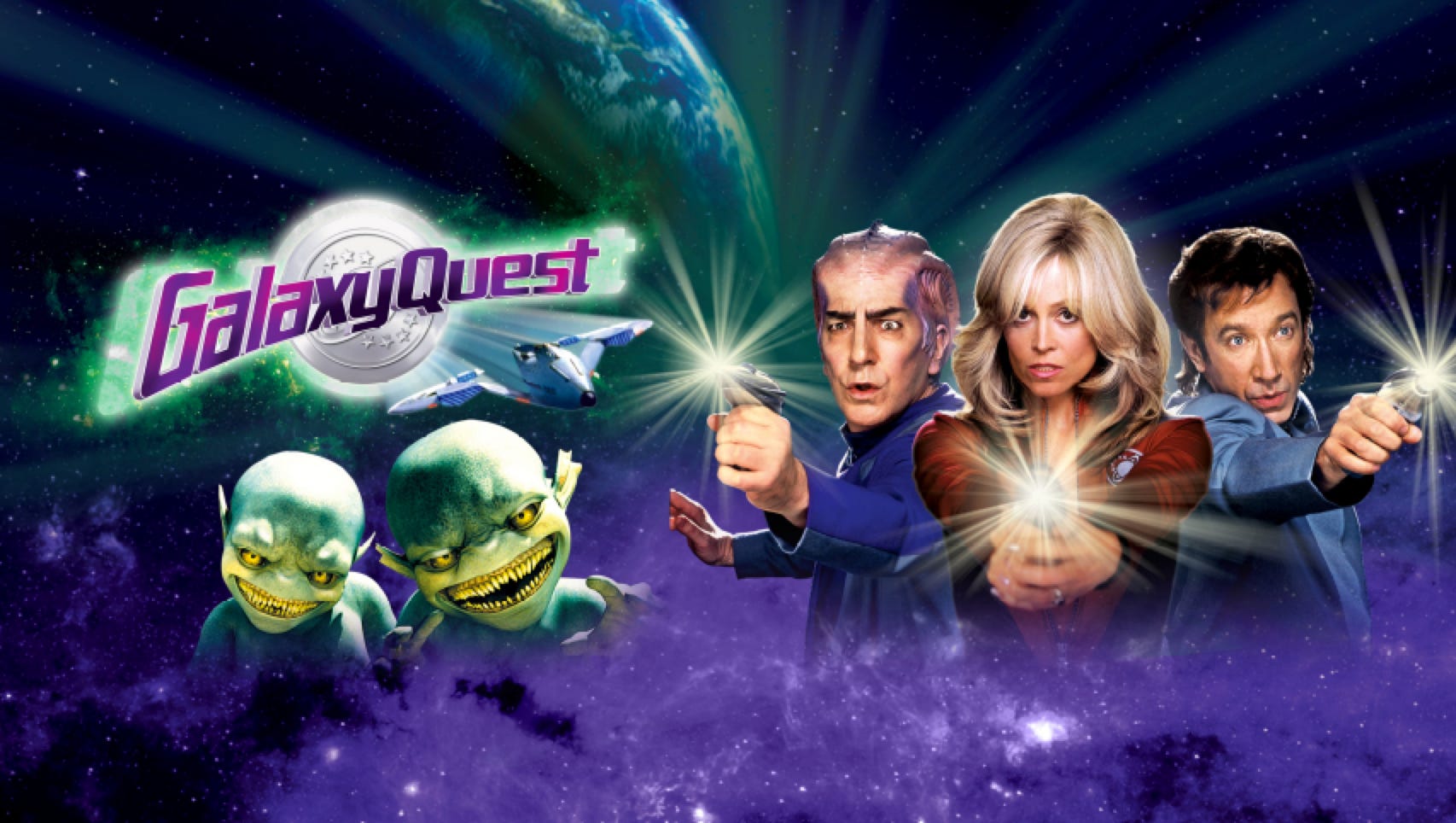
Space travel has been a perennial theme in theatrical film since as far back as Aelita (1924, Soviet Union) and Frau in Mond (1929, Germany). The Latin novel Somnium by Johannes Kepler, posthumously published in 1634, may have served as the inspiration for descriptions of journeys beyond our world. However, economic deprivation and military conflict atrophied public appeal to the extraterrestrial science fiction genre (excepting comic strip serials) until Destination Moon (1950, US) was released during the advent of postwar prosperity. Television later followed with Irwin Allen’s serious-turned-comical series Lost in Space (1965-68 on CBS), and of course, Gene Roddenberry’s iconic Star Trek (1966-69 on NBC), with its garish garb that was intended to accentuate the novelty of broadcast in color.
Costs associated with alien sets and unconventional visual effects have constrained the ability of studios to foray space dramas into a regular television format. The limited audiences (typically adolescent and young adult males) further exacerbate these hurdles. Not counting Star Trek spinoffs (especially after 2005, which shouldn’t exist), over the past half-century, only a handful such television programs can readily be recalled: Space 1999 (1975-77), Quark (1977-78), Battlestar Galactica (1978-79, 2003-09), Babylon 5 (1993-98), Firefly (2002), The Expanse (2015-22) and The Orville (2017-22).
Set (eventually) in the twenty-third century, Star Trek offered an optimistic vision of a technologically advanced future with phaser-armed warp-driven cruisers plying between interstellar celestial bodies. In the aftermath of its cancellation, its devoted fanatics (from which the term “fan” derives) began gathering at science-fiction conventions to invite speakers, attire in “uniform” costumes, as well as buy and sell trinkets, posters, action figures and other Trek-related paraphernalia. Paramount executives, noticing the expansive audiences, initiated resurrection of the original franchise onto the big screen with Star Trek: The Motion Picture (1979) a decade after the original series ended.
Sci-Fi Satire at its Best
The substantial subculture of nerds who are devoted to this silly grandiose fantasy of galactic heroism richly deserved to be mocked. Enter Galaxy Quest (1999), which this Christmas Day will mark its quarter-century anniversary as Star Trek’s premier homage and affectionate satire. Directed by Dean Parisot, the film stars Tim Allen as Jason Nesmith (aka Commander Taggart), Sigourney Weaver as Gwen DeMarco (aka Lieutenant Madison), the late Alan Rickman as Alexander Dane (aka Dr Lazarus), and Tony Shalhoub as Fred Kwan (aka Tech Sergeant Chen). Distributed by DreamWorks, the comedic film begins at a sci-fi convention with the washed-up actors ignominiously selling autographs from typecast participation in their television show that had ended eighteen years prior. That eponymous series featured a crew aboard an interstellar frigate NSEA Protector on their various dramatic adventures.
At the convention, a few teenage fans query Nesmith about technical contradictions from the episodes, and he storms off just as a troupe of real-life extra-terrestrial aliens, known as Thermians, unsuccessfully attempt to draw his attention. Afterwards, the aliens intercept Nesmith in a drunken stupor at his suburban home and transport him to their recreation of the Protector, for the purpose of asking him to negotiate with their archenemy named Roth’har Sarris, a general among the reptilian Fatu-Kray. Meanwhile, Dane (in a bungalow amidst police sirens) and DeMarco (in her upscale apartment) commiserate about Nesmith’s rude condescension towards their fans.
Impulsively, Nesmith momentarily distracts the Fatu-Kray crew through Protector’s arsenal, while oblivious to the genuine nature of this encounter until after he has returned to his home on earth. Hastily rejoining the remaining cast at a ribbon-cutting ceremony, Nesmith urges them to join him on the adventure of a lifetime – an actual space journey, as opposed to the mere pretense from yesteryear. They naturally scoff until realizing the possible benefit to their careers, even if it might be that Jason has no clue of what’s actually going on. The four cast members join Nesmith (now in uniform) aboard a sophisticated spacious star port to meet the ingenious invertebrate Thermians, who have succeeded in recreating the program’s technological imagination based on their naïve belief in the accurate historicity of the earthly television series. In a scene reminiscent of The Motion Picture showing Admiral Kirk marveling at the refitted starship Enterprise for the first time, Nesmith proudly introduces his “crew” to a fully operational and real-life Protector.
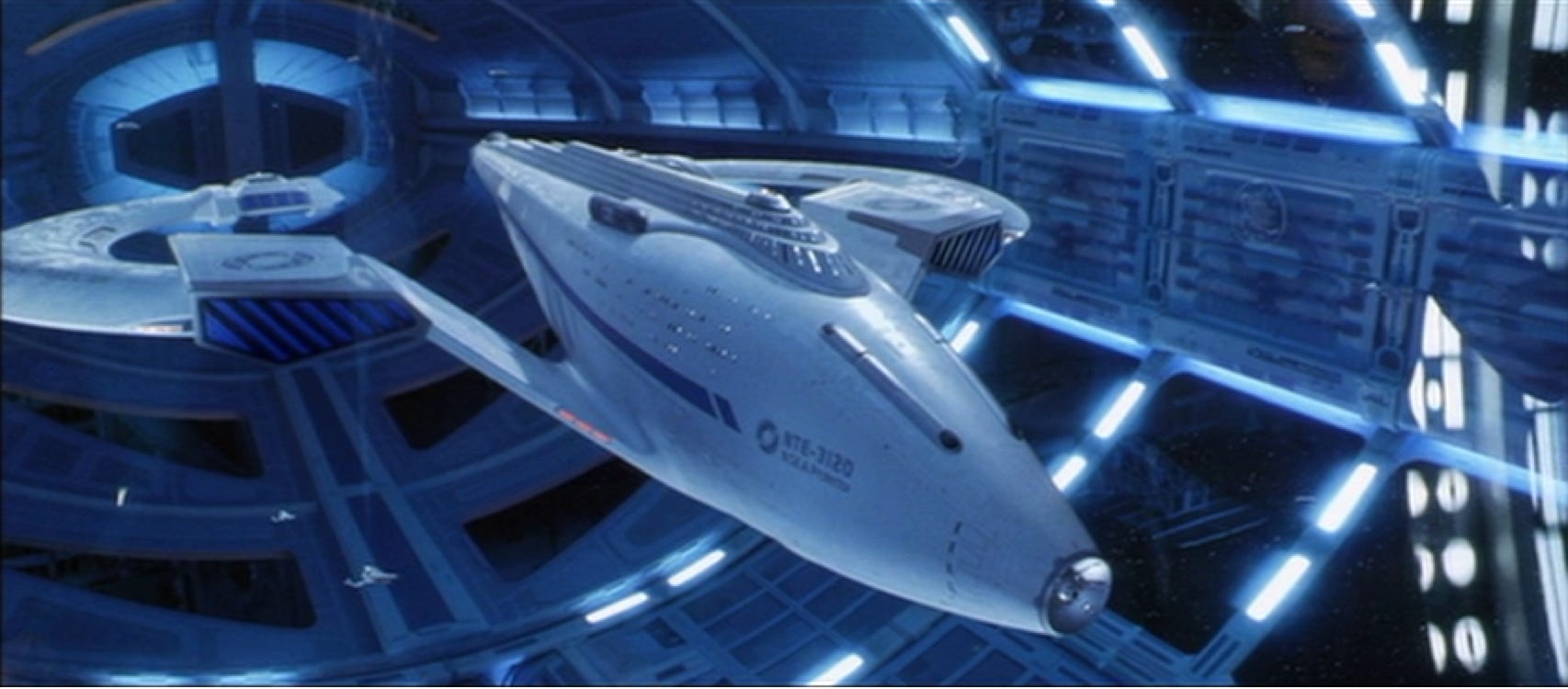
Once aboard, the actors’ unfamiliarity with the ship’s instruments and their functionality becomes embarrassingly evident on their trip to intercept Sarris again. Although providing a hilarious scene, true fans may not be able to help noticing that the depiction of the fuselage scraping the space dock interior during Protector’s departure scene is inconsistent with geometric interference from the propulsion nacelles. Needless to say, neither Nesmith nor his fellow cast members have any idea what to do, and after their narrow escape from Sarris, the Thermian leaders touchingly blame themselves for the debacle. Nesmith reassures them, and the actors set out on a shuttlecraft to a nearby planet to obtain a two-meter diameter sphere of beryllium (the fourth element in the periodic table) that will be used to regulate the quantum flux drive. But nothing is as it seems, with the dialog resembling Star Trek’s episode “Arena” from the first season. For example, the bluish miner inhabitants initially appear to resemble children, until they suddenly turn cannibalistic. Later, Nesmith is captured and is forced to confront an enormous animated rock monster.
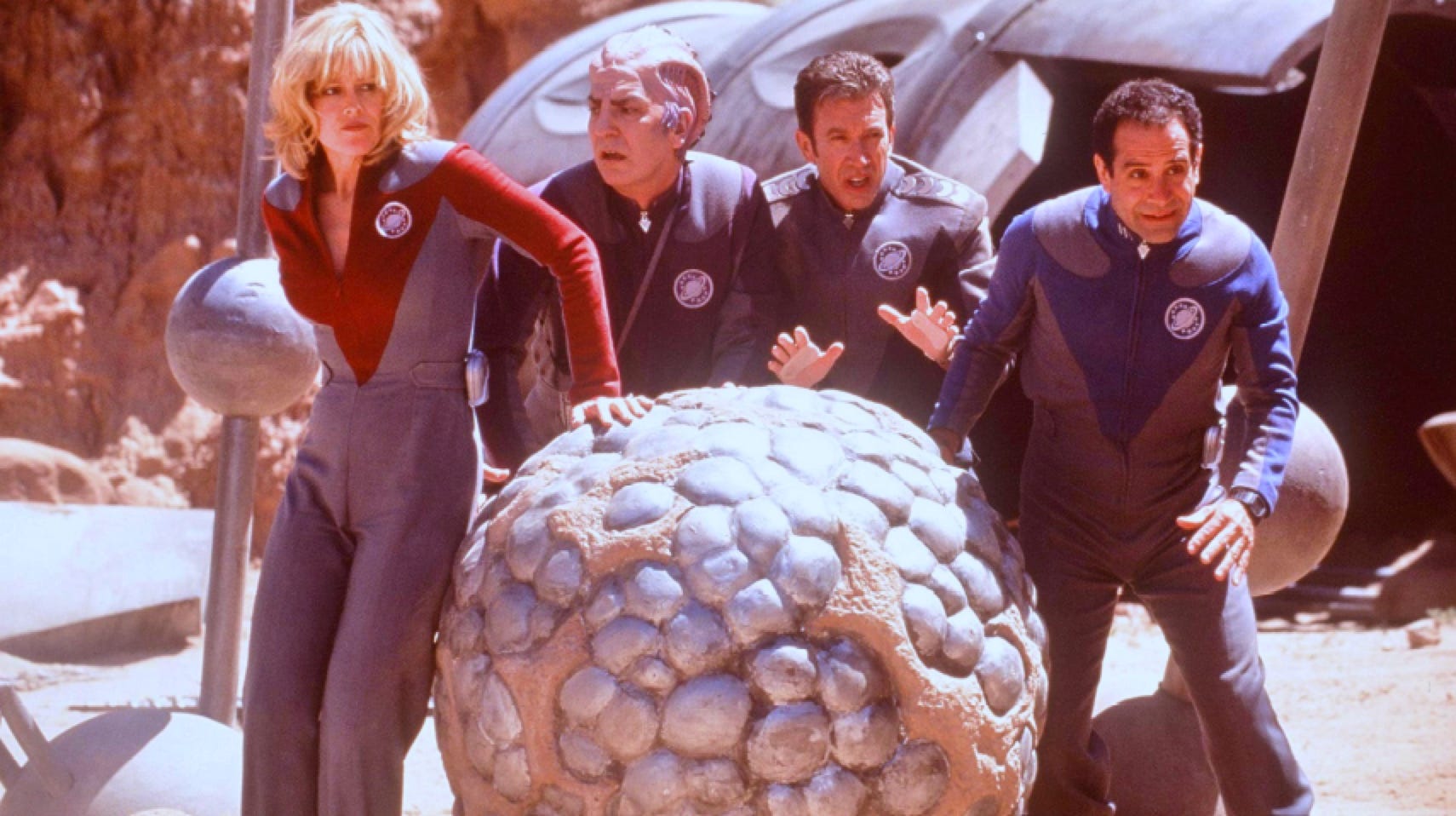
In the wake of his rescue, Sarris captures virtually the entire crew and rigs Protector’s engine core to self-destruct. Nesmith and DeMarco request assistance on fictional (but now real) engine functions from the convention’s well-versed teenagers, while Dane heroically attempts to free the trapped crew. Finally, Kwan digitally transports aboard the rock monster to wreak havoc on the Fatu-Kray guards. The actors save the day – Hurray!
On their return to earth after defeating Sarris’ cruiser, the bridge separates and crashes into the convention amid the cheer of the audience (although the film omits depiction of casualties in the parking lot and convention stage – it’s rated PG after all). Meanwhile, the Thermians resume their journey on the Protector to reconstruct their lost world that Sarris was able to destroy before Nesmith could intervene. They remain optimistic in the hopes their inventive minds may yet prevail to achieve a restoration of their society. Despite the tragedy survived by all, the movie ends on cheerful note, which includes a resumption of the television series.
A Film that Still Inspires and Entertains
As a beloved tribute to and parody of Star Trek – particularly the original series, Galaxy Quest remains a delight to Trekkies even today. The sci-fi genre presents a unique challenge to film producers, as the nerds who patronize such entertainment can be harshly critical if the world-building seems physically absurd – at least without some credible techno-babble to explain away the annoying inconsistencies. To their credit, techies recognize the limits of contemporary human understanding – we hold Jules Verne in high esteem even if acceleration from the giant cannon in De la terre à la lune (From the Earth to the Moon) could squash any humans aboard into gelatinous protoplasm. In fairness to Verne, research into practical rocketry useful for space travel wouldn’t start for another half century after his novel was first published.
Both techies and others appreciate the prodigious efforts made to create entertainment within dramas set in hostile and unfamiliar environments. Such stories can enthrall and inspire, as well as cause us to chuckle, or even laugh on occasion. Galaxy Quest represents one such accomplishment. May that this delicious example serve as a template, but please, not a sequel. Thanks.
 | A guest post by
|
I watched most of those movies and even snagged a VHS tape of Galaxy Quest (still have it in my outdated library) when the library dumped all their VHS tapes in favor of DVDs. My family found GQ a hilarious show. Thanks for the reminder of this fun show.