

A Visual Glimpse of Creation
The documentary entitled The Story of Everything offers viewers, especially younger ones who missed the heyday of the New Atheism, an introduction to observable evidence for intelligent design.

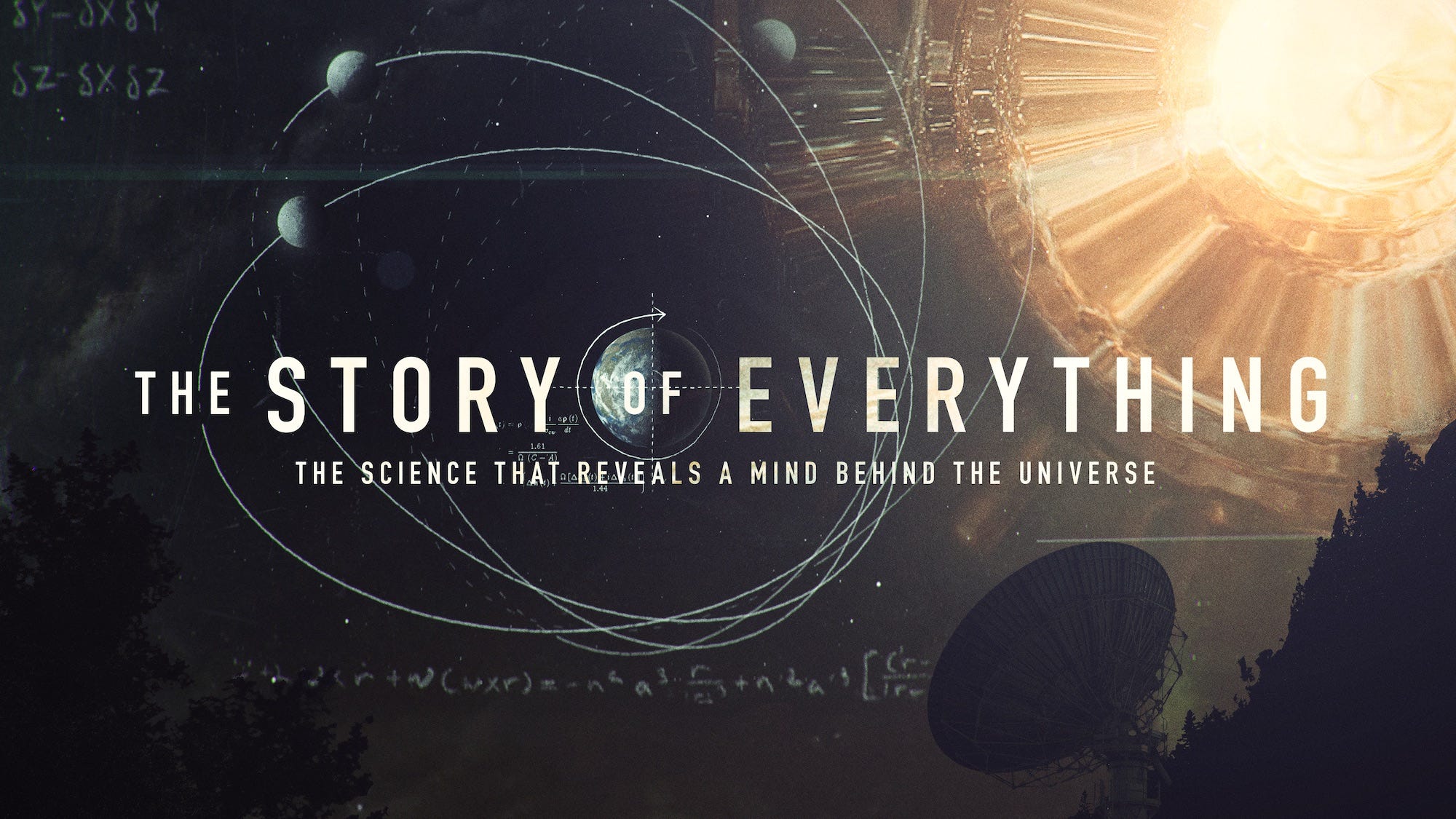
Stephen Meyer, author of Return of the God Hypothesis, has recently released a documentary film that introduces audiences to observable evidence of theistic direction. Distributed by Fathom Entertainment, The Story of Everything presents markers of measurable peculiarities from astronomy, cosmology, nuclear synthesis, micro-biology, information theory and overall aesthetic recognition of beauty that support broad indices of intentional creation. Introduced by theoretical and empirical discoveries from the early twentieth century and buttressed by more recent research into sub-cellular dynamic mechanisms and chemically-driven protein folding, Story offers insight into the materialist scientific investigations that indicate processes that originate from beyond our conceptual horizons.
Divided into chapters, Story introduces scientific consensus from the late nineteenth century which postulated an eternal and determinist (if not substantially static) universe extending through our Milky Way galaxy.
By then, classical physics had understood phenomena in terms of continuous fields that the twentieth century would eventually shatter. Doppler shifts (contracting or stretching wavelengths from approach or departure) found in light from distant nebulas and observed through telescopes suggested an expanding cosmos. Meanwhile, Einstein’s formulation of general relativity (1915) provided a theoretical foundation to characterize that phenomenon, leading to the controversial postulation of a material beginning by Belgian priest Georges Lemaître, among others. Derided as “the Big Bang” by one critic, this cosmic temporal creation gradually gained acceptance with accumulating evidence.
Discoveries from sundry fields in physics converged to alter previously established perspectives. Experiments to catalog elementary particles led to measuring formation energies that synthesize atomic nuclei, and thereby how elements formed from stars. Separately, antenna noise led to the discovery of the Big Bang’s background radiation signature. By necessity, much of the information possesses a technical flavor, balanced by expert commentary together with detailed computer animated graphics.
Apart from recounting historical physicists and their discoveries, Story also presents various interview vignettes from contemporary contributors. These include cosmologist Luke Barnes, biologist Michael Behe, mathematician Daniel Berlinski, philosopher Jay Richards – co-author of The Privileged Planet that served as the basis of its eponymous 2014 documentary, and physicist Frank Tipler – co-author of The Anthropic Cosmological Principle and chemist James Tour, among others.
A Look at the “Fine-Tuning” Evidence
Story presents audiences with details of fine-tuning regarding physical laws before segueing into molecular biology. Personally, one omitted circumstance that seems an amazing coincidence is the balance of electric charge that exists, despite their opposing sources composed of fundamentally different particles. Causal relationships between matter and energy would be readily recognized and understood by former students of physics, chemistry and engineering, although the reproductive process of deoxyribonucleic acid (commonly abbreviated as DNA) and its instructional synthesis of protein formation might be more familiar to biologists.
In its narrative, Story suggests that Darwinian natural selection may thereby present insufficient explanative ability to account for metabolic adaptation, offering instead conscious design by an external conceiver. Although sharing my lack of biological knowledge with Justice Jackson, that deficiency hasn’t prevented me from expressing personal biases. My inchoate view maintains that some form of genetic mutation regulated by environmental conditions either produced or initiated corporeal variation among living organisms, irrespective of whether additional influences that yet remain unrecognized might also have played key roles. While perhaps hinting at continuous biochemical iteration, Story doesn’t reject a pre-established framework that unwinds naturally – implicitly comprising whatever mechanisms that provide for inherent consanguineous creation of life.
Story asserts that multi-cellular forms appear to have developed spontaneously, as with the Cambrian explosion (half-a-billion years ago), exhibiting non-linear sequences (that the late Stephen Jay Gould called “punctuated equilibrium”), which Meyer demonstrates with the eyes of a trilobite fossil. Story doesn’t declare continuous guidance in morphological changes over time, which constitutes my primary concern over the label “intelligent design” as a stalking horse for creationism. Instead, Story suggests that specific gravitational and quantum intricacies for producing atoms to collapse into celestial bodies could also extend to chemical and biological processes that yield life and ultimately conscious awareness. All of this requires pre-existing information to design such a cosmos.
The Question of Design and the Supernatural
Story permits us to accept a supernatural event. New York Times columnist Ross Douthat similarly presents in Believe rational justification for spiritual belief. However, the consistency of physics (despite knowledge gaps) precludes routine non-natural or miraculous events, which by necessity must remain rare, non-repeatable, and typically un-recordable. The seventeenth century philosopher Baruch Spinoza postulated a deity that didn’t intervene on our behalf, apart from providing material existence governed by rational laws.
Many physicists resist the notion of theistic intervention in our material cosmos. In recent years, the initial Creation has been erased to constitute an effectively repeatable event called Conformal Cyclic Cosmology or CCC, as introduced and promulgated by the eminent Oxford emeritus professor Sir Roger Penrose. As commented on by critics, the CCC proposition currently necessitates the elimination of matter between the end of a concluding universe and the beginning of the next, as well as the erasure of information to reduce total entropy – the former necessitating obscure particle decay, while the latter refuting contemporary understanding of quantum mechanics.
The notion of events being in God’s hands negates our agency (not to mention natural phenomena that result from physical laws). Moreover, such pre-destination effectively denies Free Will – an essential concept for Christian salvation that proposes salvation to all human souls ratified by individual acceptance. This condition further complicates voluntary acceptance of Christian morals, as societal stability might benefit the entire neighborhood, but can only be driven by presumed acceptance of the incentives derived from promised eternal reward.
Skeptics who doubt or even reject such assertions can rationally decide to thwart ethical norms for their own personal benefit, while disregarding the risk of unpleasant eternal consequences. Meantime, victims in society may suffer unrequited hardship from selfish or callous behavior of non-conformists. Thus, impulsive or indifferent persons may need enforceable persuasion by threats of authorized temporal punishments imposed by the societies in which they reside, due to their disregard for moral codes, based either on the expectation of holy judgment, or familiarity within the local community.
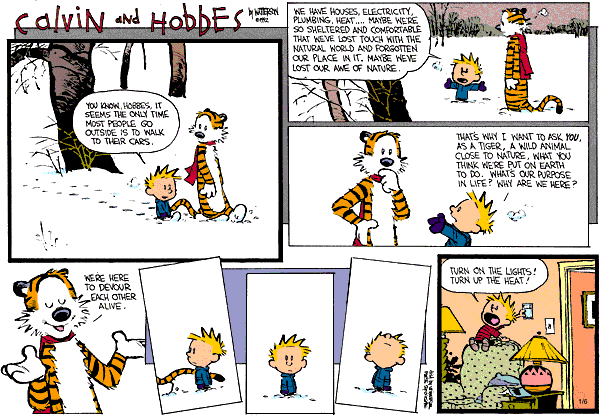
Story ultimately asks whether evidence for creation presupposes some ultimate purpose in our existence. Perhaps such a query contains a moral derivation, such as recognition of common dignity for all human beings, irrespective of actual, potential or perceivable contribution by any specific individual. Of course, not all will agree as Hobbes tells Calvin, “we’re here to devour each other alive.” We ought to be careful to avoid conflating God’s design with human destiny, whether in general or for any particular person. Any one of us could be unexpectedly hit by a proverbial truck, as happened to a pivotal character in a first season Star Trek episode.
Nonetheless, our recognition of a Divine Authority as reflected in the vast cosmos can inspire us to go forth, confident in our inalienable rights bestowed by the Old One who created us in His cognitive image (Genesis 1:27) and granted us dominion (Psalms 8:4-6). As Doc Emmett Brown extolled Marty McFly at the conclusion of the film Back to the Future Part III, “the future isn’t written. No one’s has. So make it a good one.”
This would seem to be the main moral lesson offered from Meyer’s new Story documentary.
Photo Credit- IMBD
 | A guest post by
|
I did enjoy that movie.