

A Republic, if You Can Keep It
Is America at an inflexion point where we are in danger of losing our republic and devolving into some multi-cultural "democracy" whose chaos will usher in some form of tyranny?
When Benjamin Franklin departed the Constitutional Convention at the close of the final session on September 17, 1787, he was approached by socialite Mrs. Elisabeth Powel, who asked, “What have you given us, Dr. Franklin, a monarchy or a republic?” He replied: “A republic, if you can keep it.”
The term “republican” in this essay refers not to the Republican party but rather to the political and cultural ideology that binds a people or nation over the generations to a republican form of government, just as siblings are bound to their parents. I will examine the “republican idea”; consider how the abandonment of that ideal inexorably led to the collapse of the Roman Republic; and what are the implications for our own democratic-republican polity.
In our political-cultural war, the nature of the struggle is finally changing. Authoritarian neo-Marxists seeking to impose their will are for the first time facing citizenry aroused to defend American exceptionalism. Patriots are organizing and fighting back. They are even winning early skirmishes against the would be Marxist tyranny in the fight against CRT and systemic election fraud. You can win a war only if you fight it.
American exceptionalism gives primacy to God-given individual rights; the rule of the law based on consent of the governed (republicanism); a written constitution; equality under the law; individual responsibility; representative democracy; and laissez-faire economics. American exceptionalism is thus a charter and exemplar for us and other nations.
Since Obama’s 2009 inauguration, the political-cultural war has become increasingly one sided. Goliath is the authoritarian neo-Marxist coalition of Islamists, transgender activists, climate fanatics, anti-Semites, corporate crony socialists, “friends of China,” the Deep State, Antifa fascists, BLM racists, financial and political opportunists, and “progressive media” groupies.
On the other side has been the “righteous remnant” (biblical term) willing to take the field against Goliath. These happy few are the believers in American exceptionalism: the Tea Party and conservative Christian and Jewish groups. Trump’s support in 2016 and 2020 showed the righteous remnant was in fact the majority. Nevertheless, Marxist authoritarians had already seized the commanding heights of American political culture: (social) media, academia, entertainment, and Deep State.
In this war, there is no shortage of bad news, but let us first consider the recent good news: mounting protests opposed to the LGBT onslaught against boys and families; widespread, organic, parental counterattacks against CRT in schools; and pushback against woke harassment.
Imagine that 225 years later Benjamin Franklin again posed the question—can we preserve the culture and form of our republican government? Keep in mind John Barnhill’s truism: “When the people fear the government, there is tyranny. When the government fears the people, there is liberty.”

In the modern Anglo-American conception of a republic, sovereignty rests with the people. The state is to be ruled by citizen-representatives; and there’s no hereditary principle. From the Constitution and the Federalist Papers, we know this modern formulation is close to the Founders’ understanding of the Republic they were creating out of a loose confederation of the original thirteen colonial states.
The Founders were steeped in classical history and political theory, especially that of the Roman Republic and Athenian democracy. A review of how Roman republican political culture withered away from 133 to 44 BCE can inform an understanding of a similar collapse in our political culture from 1970 to the present.
The Roman Republic was admired for its durability and stability, which allowed Rome to extend its power and influence worldwide. Other forms of government (oligarchy, monarchy, despotism, tyranny) have inevitably and consistently failed because the political base was too narrow. Without consent and support of the governed, these inflexible polities could not sustain a long fight against foreign enemies; anarchy and incessant civil war became the norm in the absence of agreed rules of governance.
Founded in 509 BCE after overturning a monarchy, the Roman Republic fought many defensive and aggressive wars in its first four hundred years. After major defeats—the Gauls in 387 BCE and Carthaginians in 216 BCE—the Republic nevertheless displayed extraordinary resilience and always managed to bounce back from defeat. Likewise, America was founded and then survived in the white hot forge of war against the great powers: French & Indian War; War of Independence; War of 1812; Civil War; WWI; WWII.
The domestic history of the Roman Republic was, if anything, even more desperately turbulent than the foreign wars. The Conflict of the Orders (500-287 BCE) saw unceasing social and political conflict between patricians (Senatorial oligarchic elite) and the more numerous plebeians (the people). The latter finally achieved political equality during the 3rd century BCE. In the 2nd century BCE, several social reformers (Populares) tried to pass agrarian reform laws. Eventually, agreement between the two sides irreparably broke down during the tribuneships of the two succeeding Gracchi brothers.
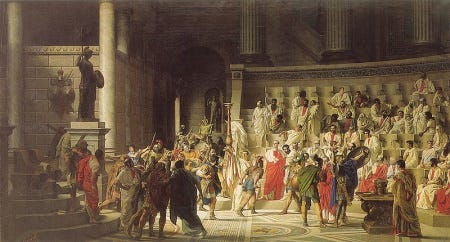
For almost four hundred years until 133 BCE, there had been an implicit compact between the contending parties (patricians vs. plebs): the political contest would be settled by the rule of law. This commitment and attachment to the “republican idea” has distinguished Roman and American political culture from any other.
The essence of the “republican idea” in these two political cultures—and perhaps accounting for their unparalleled success—is, surprisingly, not merely the positive written law (statutory and constitutional), which was developed over centuries. Important as that was, what’s paramount is devotion and adherence to this principle: thou shalt not cross certain red-line limits (violence) on political-legal activity. Power is to be transferred by honest elections.
A political party may vigorously fight for power under the rule of law, and both parties implicitly agree not to use violence or fraud to seize and hold power. With the exception of our Civil War and with no exception in the early Roman Republic, contending parties were faithful to this republican ideal. What frayed and then ripped asunder the Roman political compact was distrust between the parties that grew into political paranoia in the period immediately before and during 133-121 BCE in Rome; in 1856-1861 and then 1992-2020 in the U.S.
Aristotle had his students study the constitutions of 170 Greek city-states, based on his own model analysis of the Athenian constitution. He concluded that “republics tend to decline into democracies, and democracies degenerate into despotisms.” As terrible as a despotism (absolute power) is, the very worst form of government is tyranny, where the ruler(s) not only have absolute power, but there is no law at all. The tyrant often comes to power with the support of the many vs. the few in a lawless democracy.
Therefore, we must expect that at this critical inflexion point in the history of our Republic, the choice is now between the republican ideals of American exceptionalism and an authoritarian polity like fascism or tyranny.
Photo Credit- National Review, National Postal Museum, Study. com.